What Are Your Guests Saying? How to Read Your Google Reviews With AI
Copy your last 100 Google reviews into an AI assistant, sort them into food, service, wait, price and room, and find the one theme that moved this quarter. The prompt, what the answer looks like for a demo café, and how to tell a real change from noise before you act on it.

Alex Riesenkampff
8 November 2026 · 11 min read · Markdown
To find out what guests are saying, copy your last 100 Google reviews into an AI assistant with their dates. Ask it to sort every review into five themes (food, service, wait, price and room), count each theme this quarter against last, and quote the reviews behind the biggest change. Then read those reviews yourself and change one thing. Google already groups your reviews into topics on Maps, but it won't tell you which one moved since the summer, and that's the one to act on.
Doesn't Google already sort your reviews into themes?
Partly: Google groups reviews into Place Topics on Maps, but only once a venue has enough reviews, and the topics show what guests talk about without showing what changed this quarter. They are the words a guest can tap on your listing to filter the reviews to that topic. Google's help page calls them "main themes" that are "based on the reviews of your business". They appear only "when your business has enough customer reviews", and if your profile has none, "Google can’t create them on demand".
They also carry no dates. A pub landlord who sees "Sunday roast" among the topics knows guests talk about the roast, but can't see whether they started complaining about it in September.
Google also writes AI summaries of places from their reviews. Its developer documentation describes them as "based solely on user reviews", and lists the United Kingdom among the supported regions. Three in five British consumers (60%) already trust AI-generated review summaries, in a CGA by NIQ and Reputation survey of 755 consumers in August 2025. So whatever keeps coming up in your reviews is what many guests will believe about you before they arrive, whether or not they read a single review. Our guide to Google's AI Overviews and AI Mode for venues covers what else those answers draw on.
Step 1: Copy your last 100 reviews, with their dates
Work from your most recent 100 Google reviews, each with its star rating and date, because they describe the venue you run now and they are the ones guests read. In BrightLocal's 2026 survey of 1,002 US adults, 74% said they look for reviews written in the last three months. So count by quarter.
The quickest way to get them is Google Maps on a laptop: open your listing, go to Reviews, sort them newest first and copy them into a document. Maps shows how many weeks or months ago each review was posted, which is close enough to sort them into months.
For a café that gets four or five reviews a week, 100 reviews covers about six months, which gives you two quarters to compare. If you get fewer, go back a year. Leave out reviewers' names; the themes don't need them. If your pub's reviews are split between Google and Tripadvisor, copy both and mark which site each one came from, so you can count them separately.
Step 2: Sort them into five themes with one prompt
Give the AI a fixed list of themes and what each one covers, so it counts the same way every quarter instead of inventing new labels each time. The SemEval-2014 research benchmark, built from over 3,000 sentences of restaurant reviews, sorted them into food, service, price, ambience and "anecdotes/miscellaneous".
Those categories still fit a café or a pub, with two changes. Split wait out of service, because the fix sits somewhere else: a slow flat white at 10am on a Saturday is usually a rota or layout problem, while a cold welcome is a training one. And call ambience "room", so it also catches seating, heat and toilets.
| Theme | What guests write about | Where the fix usually sits |
|---|---|---|
| Food | Taste, temperature, portions, choice, dietary options | Kitchen, menu, suppliers |
| Service | Welcome, attention, mistakes, how a complaint was handled | Training and briefings |
| Wait | Queues, slow drinks or food, waiting to order or pay | Staffing at peak, layout, menu length |
| Price | Value, portion for the price, service charge | Prices, portions, what is included |
| Room | Noise, seating, heating, cleanliness, toilets, music | Furniture, cleaning, maintenance |
The prompt below works in ChatGPT, Claude, Gemini or Copilot. Paste the reviews where it says so.
Sort your Google reviews into themes
I own [venue name], a [café / pub / restaurant / bakery] in [town]. Below are my most recent Google reviews, each with its date or month and its star rating.

[paste your reviews]

1. Sort every review into these themes. One review can belong to more than one.
 - Food: taste, temperature, portions, choice, dietary options
 - Service: welcome, attention, mistakes, how a complaint was handled
 - Wait: queues, slow drinks or food, waiting to order or pay
 - Price: value, portion for the price, service charge
 - Room: noise, seating, heating, cleanliness, toilets, music
 Put anything else under Other. Set aside reviews with stars but no text.
2. Mark each mention positive, negative or mixed.
3. Make a table: theme, mentions in [last quarter, e.g. May to July], mentions in [this quarter, e.g. August to October], and how many of this quarter's were negative.
4. Name the theme whose count changed most between the two periods. Quote the three reviews that show it best, word for word, with their dates.
5. If a theme has fewer than five mentions in both periods, say the numbers are too small to compare.
6. List every review you were unsure how to read, including anything that might be sarcastic, and say why.
7. Do not suggest causes or fixes. Report only what the reviews say.
Instructions 4 to 6 do most of the work: word-for-word quotes let you check the count, the small-numbers line stops it ranking noise, and the doubtful list catches sarcasm. Our ChatGPT prompts for restaurants cover what to strip out before you paste anything else from the business into a chatbot.
What the answer looks like for a demo café
A useful answer is a short table and one sentence naming the theme that moved, with the reviews behind it quoted. Here is the prompt run on 100 reviews for The Willow Pantry, a demo café in Manchester: 48 from May to July and 52 from August to October, nine of them stars with no text.
| Food | 29 | 31 | 3 | Cardamom buns and the eggs; a few cold plates |
| Service | 15 | 13 | 2 | Friendly, remembered regulars |
| Wait | 4 | 13 | 12 | Weekend brunch queue, slow drinks |
| Price | 6 | 8 | 4 | Dear for brunch, fair for coffee |
| Room | 11 | 9 | 3 | Light and dog-friendly; cramped at the back |
Wait went from 4 mentions in 48 reviews to 13 in 52, and 12 of the 13 were negative, while the star average over the same two quarters slipped only from 4.6 to 4.5. A glance at the stars would have missed it. The answer named wait as the theme that moved and quoted three of the demo reviews, all from weekends, among them "Waited 20 minutes to order on Saturday, then the coffee took another 15."
Price went from 6 to 8 and room from 11 to 9. That is normal wobble at these numbers.
Step 3: Read the reviews behind the theme that moved
Read every review behind the theme before you change anything, because sarcasm, one bad weekend or the same word meaning different things can all inflate a count. At The Willow Pantry, nine of the 13 wait reviews were about Saturday or Sunday brunch and two were about a slow weekday lunch. One praised how fast the team cleared a queue.
The thirteenth was on the doubtful list: "Loved the 25-minute wait for a flat white, very zen." The AI counted it as a complaint, which is right, but another run could read it as praise. In SarcasmBench, a 2024 test of eleven large language models on six sarcasm datasets, the models did worse at spotting sarcasm than older systems trained for that one job. Reading the reviews yourself is the check.
Small counts also wobble. With 50 reviews a quarter, a theme mentioned six times can come back as two or as eleven with nothing at the café changing. Tim Martin, Wetherspoon's chairman, made the same point in October 2025 when a press story leant on one pub's Tripadvisor score: "Reviews on TripAdvisor are based on a very small sample- 26 in this case."
So treat a move of three or four mentions as noise, and act on a theme that has at least doubled and reached ten or more mentions. The doubling rule is for spotting change. A theme that stays high and mostly negative every quarter, say ten complaints a quarter, is a standing problem to fix even though it hasn't moved. If you have too few reviews to compare at all, that is a different problem, and our guide to how many Google reviews a restaurant needs deals with it.
Read for the cause, and don't pin it on one person. When Super44 read the reviews of a café and events venue in London, the complaints its owners had put down to bad staff traced back to a small gap in training.
Step 4: Change one thing, and check it next quarter
Choose the cheapest change you can reverse that goes at the cause, run it for four weekends, and run the same prompt next quarter to see whether the count falls. At The Willow Pantry, nine brunch complaints point at 9am to noon on Saturday and Sunday, when one barista makes every drink.
A second pair of hands for those three hours each day is six hours a week. At about £16 an hour all in, which is what an hour of minimum-wage staff really costs once National Insurance, pension and holiday are added, that is about £96 a week, or about £384 for a four-week trial. Tell the Saturday barista what the reviews said before the rota changes, so it lands as help rather than blame. If the extra hours go to someone already on the team, our guide to building a fair staff rota covers sharing weekend shifts without wearing out the same two people.
The advice changes if wait mentions stay high with two people on. Then the bottleneck is the coffee machine or the kitchen pass, and a shorter weekend brunch menu may be the cheaper fix.
If wait mentions fall from 13 back towards 4 next quarter, the second pair of hands worked. When Super44 read every Google review for a café in Cologne with a large review base, weekend staffing was the biggest piece of the recovery plan it costed, worth about €1,800 a month.
Before you act on a theme
- It moved, or it never goes awayAt least double last quarter and ten or more mentions, or high and mostly negative every quarter.
- You read itEvery review behind it, and they describe the same thing.
- You know whenThe day, time, dish or corner of the room it happens in.
- The fix is smallThe cheapest change you can reverse, with a date to run the prompt again.
- Nobody is blamedTalk to the team about the pattern before the rota or the menu changes.
The reviews behind the theme still need answers. Our guide to replying to Google reviews with AI has a prompt for each kind that tends to go wrong.
Let Super44 read them every week
Super44 does this reading for you, with no copying. On a Monday morning, ask it "What are my guests saying in my last 100 Google reviews?" You get each theme with how many reviews raise it and since when, newest complaints first, with the reviews behind any of them one question away.
It says when an old complaint has stopped turning up, so you don't fix last year's problem, and it tells you when your last 90 days' rating differs from your all-time average. It also notices what guests leave out: a London café and events venue's signature courtyard turned up in only 12% of its reviews, so Super44 recommended making it the centre of its marketing. Ask it to do the same every Monday and it will.
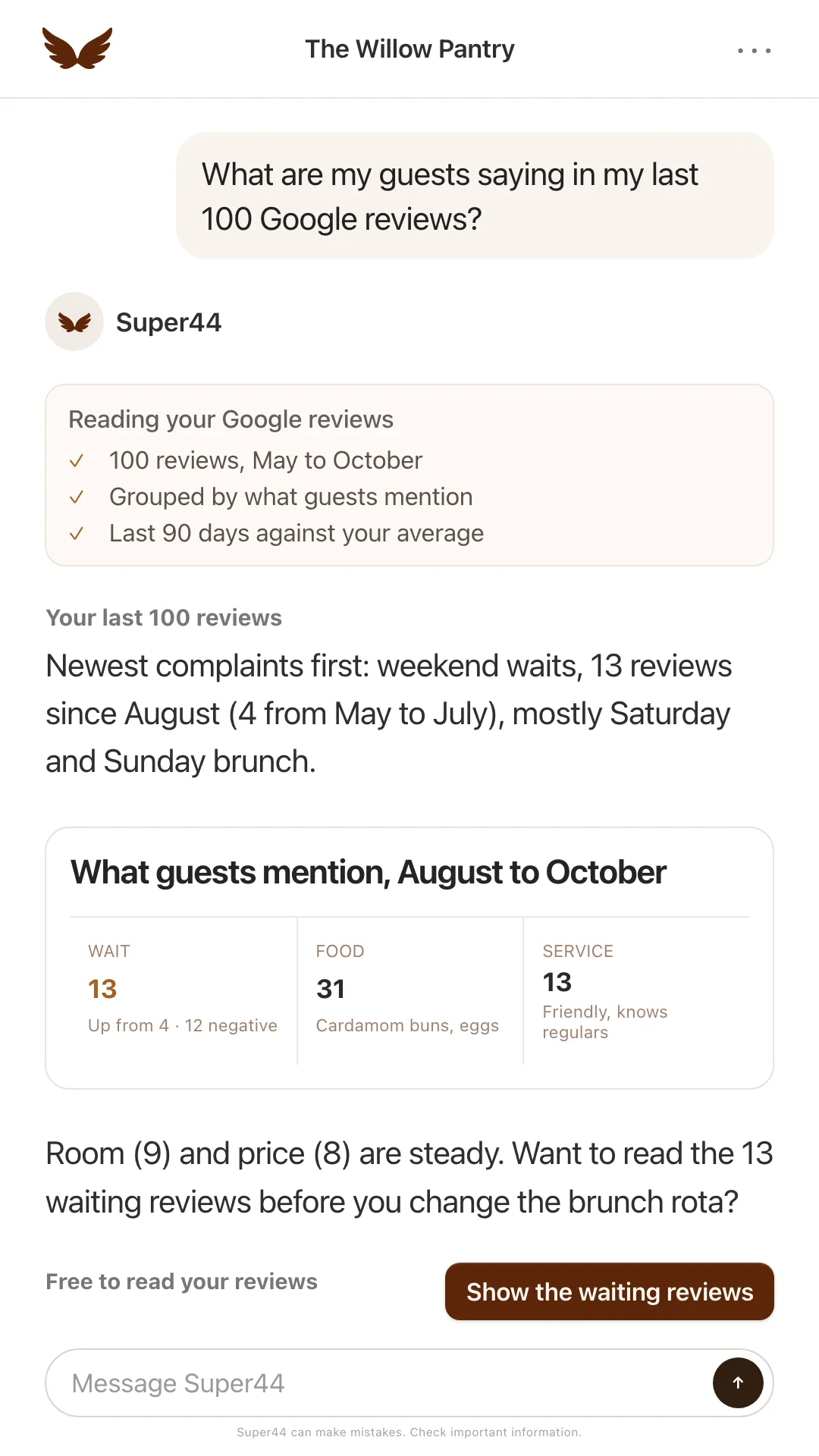
When a new review lands, Super44 tells you with a reply already drafted in your voice, and once you approve it, the reply posts to your Google profile. After five approved replies you can let it answer the star ratings you choose by itself, and anything delicate still comes to you. Reading your reviews and drafting replies is free; posting more than your first three replies, and automatic replies, come with Core at £19 a month.
Frequently asked questions
How can AI help me understand what customers are saying in my reviews?
Paste your last 100 Google reviews into an AI assistant with their dates and star ratings, and ask it to sort each one into five themes (food, service, wait, price and room), count each theme by quarter and quote the reviews behind the biggest change. Then read those reviews yourself before acting, because with around 50 reviews a quarter a theme can move by three or four mentions by chance.
How many reviews do I need before the themes mean anything?
Around 50 a quarter is enough to compare one quarter with the last. With fewer, compare half-years or simply read every review yourself, and treat any theme with fewer than five mentions in both periods as too small to call. Google itself only creates Place Topics for a business once it has enough customer reviews.
What's the best way to manage reviews across Google and Tripadvisor for my pub?
Copy both into one document with the site marked on each review, sort them into the same five themes, and compare each site with its own last quarter, because a site with few reviews swings on one bad night. Reply on the site where each review was left.
Is it safe to paste my Google reviews into ChatGPT?
Public review text is low risk, since anyone can read it on Google Maps. Leave out reviewers' names, never paste booking details, till records or staff notes alongside the reviews, and keep the output to yourself if it names members of your team.
Can Super44 read my Google reviews for me?
Yes. It reads your Google reviews without any copying, tells you each theme with how many reviews raise it and since when, shows you the reviews behind any theme, and drafts a reply to each new review in your voice. Reading your reviews and drafting replies is free. Posting more than your first three replies, and automatic replies for the star ratings you choose after five approvals, come with Core at £19 a month.
Sources
- Google Business Profile Help: Understand business summaries on Google Maps (Place Topics) — "These main themes are based on the reviews of your business." "Topics are only created when your business has enough customer reviews." "If your business doesn’t have Place Topics, Google can’t create them on demand." "To filter reviews by Place Topics, users can click different topics." Checked 6 November 2026.
- Google Maps Platform: AI-powered review summaries — "AI-powered review summaries are AI-generated summaries of places based solely on user reviews." The United Kingdom is one of 18 regions listed for English. Checked 6 November 2026.
- Google Business Profile Help: Download your Business Profiles to a spreadsheet — The download lists profile data, with optional Google update information and photos; the page does not mention reviews. Checked 6 November 2026.
- Google Business Profile Help: Manage customer reviews — "Go to your Business Profile." "Select Read reviews." "Customer reviews can give helpful feedback about your business." Checked 6 November 2026.
- CGA by NIQ and Reputation: AI and economic pressures driving new UK consumer habits in hospitality (30 September 2025) — Nationally representative sample of 755 consumers in Britain, August 2025. "Three in five (60%) already trust AI-generated review summaries that distil sentiment from high volumes of feedback". Checked 6 November 2026.
- BrightLocal: Local Consumer Review Survey 2026 — Representative panel of 1,002 US adults, published 11 February 2026. "74% seek reviews written in the last three months." Checked 6 November 2026.
- SemEval-2014 Task 4: Aspect Based Sentiment Analysis — Restaurant categories: "food", "service", "price", "ambience", "anecdotes/miscellaneous". "This dataset consists of over 3K English sentences from the restaurant reviews of Ganu et al. (2009)." Checked 6 November 2026.
- Zhang, Zou, Lian, Tiwari and Qin: SarcasmBench, arXiv 2408.11319 (August 2024) — Eleven large language models and eight pre-trained language models on six sarcasm benchmarks: "current LLMs underperform supervised PLMs based sarcasm detection baselines across six sarcasm benchmarks." Checked 6 November 2026.
- J D Wetherspoon plc: Statement re Press Comment (RNS 2553C, 6 October 2025) — Wetherspoon chairman Tim Martin: "Reviews on TripAdvisor are based on a very small sample- 26 in this case." The release compares a TripAdvisor rating of 3.2 from 26 reviews with a Google rating of 4.2 based on 874 for the Scribbling Mill, Leeds. Checked 6 November 2026.