Minimum Wage 2027 Calculator: What £13.21 From April Costs Your Team
The minimum wage rises to £13.21 an hour for staff aged 21 and over on 1 April 2027. Enter your team by age band to see the weekly and yearly increase with employer NI, pension and holiday cover on top, and what it costs to keep your supervisors above the new floor.

Alex Riesenkampff
8 November 2026 · 14 min read · Markdown
The minimum wage in 2027 is £13.21 an hour for staff aged 21 and over, from 1 April 2027: 50p more than today's £12.71. Staff aged 18 to 20 go to £11.27, and 16 and 17 year olds and apprentices to £8.31, every rate up 3.9%. Take a café paying today's minimums: four baristas on 30 hours, two 19-year-olds on 20 hours and a 17-year-old who works Saturdays. From April that's £79.28 a week more in wages, or £5,189 a year with employer National Insurance, pension and someone covering holidays. Enter your own team by age band:
Minimum wage 2027 calculator
What the April 2027 rates cost your team
Enter each age band as it will stand in April: how many people, the hours each works in a normal week, and what you pay them now. Leave a band at 0 if nobody is in it.
What you pay them today, even if they turn 21 before April. On £13.21 or more, no rise is needed.
What you pay them today, even if they turn 18 before April. On £11.27 or more, no rise is needed.
At least £8.00. On £8.31 or more, no rise is needed. An apprentice aged 19 or over and past their first year goes in their age band.
Extra wages a week from April
£79.28
Extra cost a year, all in
£5,189
Extra wages a year (52 paid weeks, holiday included)
£4,123
Employer National Insurance on top, a year
£468
Employer pension on top, a year
£94
Holiday cover on top, a year
£504
Sales a week at 10p more to pay for it, after 20% VAT
1,197 sales
Minimum wage rates from April 2027
Every legal minimum rises by the same 3.9% on 1 April 2027, after the government accepted the Low Pay Commission's recommendations in full on 28 October 2026. Around 330,000 hospitality jobs are paid at or close to the minimum, by the industry estimate Restaurant Online reported the day before. Allen Simpson, chief executive of UKHospitality, said: "For a labour-intensive sector like hospitality, wage increases of this scale represent a considerable additional burden that many businesses will struggle to absorb."
| Age band | From April 2026 | From 1 April 2027 | Rise an hour |
|---|---|---|---|
| 21 and over (National Living Wage) | £12.71 | £13.21 | 50p |
| 18 to 20 | £10.85 | £11.27 | 42p |
| 16 and 17 | £8.00 | £8.31 | 31p |
| Apprentice (under 19, or 19 and over in the first year) | £8.00 | £8.31 | 31p |
| Accommodation offset, per day | £11.10 | £11.53 | 43p |
Last April the 18 to 20 rate rose 8.5%, more than twice the adult rise, as the government moves young workers towards the adult rate. This year the Commission paused that because demand for young workers has slowed, though it says there is still potential to lower the adult age limit, especially for 20 year olds. Our guide to what the April 2027 rise means for a venue covers the reasoning and the pricing decisions behind it.
The expensive date for a small team is a birthday. A 20-year-old on 30 hours who turns 21 moves from £11.27 to £13.21: £3,026 a year more in wages, and £2,342 in employer National Insurance for the first time unless the allowance covers it. Put each person in the band they'll be in for most of the year, and run the numbers again when someone's 21st lands.
What the rise costs for one person
For someone aged 21 or over on 30 hours, the 50p step costs £780 a year in wages and £920 with National Insurance and pension. The table assumes 52 paid weeks, a used-up Employment Allowance and, for adults, enrolment in your pension.
| Who | Hours a week | Extra wages a year | With NI and pension | With holiday cover too |
|---|---|---|---|---|
| 21 and over | 16 | £416 | £491 | £544 |
| 21 and over | 30 | £780 | £920 | £1,020 |
| 21 and over | 40 | £1,040 | £1,227 | £1,359 |
| 18 to 20 | 20 | £437 | £437 | £484 |
| 18 to 20 | 30 | £655 | £655 | £726 |
| 16 and 17, or apprentice | 8 | £129 | £129 | £143 |
Staff under 21, and apprentices under 25, carry no employer National Insurance on pay up to £967 a week. Nobody is put into a pension automatically before 22, so a younger worker's rise costs the wage and nothing else unless they've opted in. Our employee cost calculator prices a whole hire, rather than just the rise, if you're recruiting before April.
Put the adult row in coffees. A 10p rise on a flat white or a pint brings in 8.3p once 20% VAT is taken off, so the £920 for one 30-hour barista is about 212 of those sales a week, or 30 a day. Our guide to raising menu prices without losing customers covers which items to move.
Staff paid just above the minimum
Nobody on £13.21 or more needs a rise by law, but anyone you pay under £13.71 ends up less than 50p above the floor. The Low Pay Commission's 2025 report found that rises in the National Living Wage "continue to narrow pay differentials between jobs paid at the wage floor and those paid slightly above it", and several employers told the Commission they had reached the limits of how far that can go.
Picture your supervisor on £13.50, who opens at 7 and cashes up at 6. Today she's 79p above the newest barista. On 1 April, if you change nothing, she's 29p above them. The second calculator prices four ways to handle it.
Pay differential calculator
What keeping the gap above £13.21 costs
For staff paid above £12.71 today: a supervisor, a cook, the barista who has been with you for years. Enter one group on the same rate at a time.
Above the current £12.71 floor.
Their lead over the floor if you pay only what the law needs
29 p
Legal minimum only, a year
£0
Keep at least your smallest gap, a year
£902
Their new rate with your smallest gap
£13.71
Same lead in pence (50p rise each), a year
£2,148
Same lead in percent (3.9% rise each), a year
£2,281
With two supervisors on 35 hours at £13.50, the four answers are:
- Pay only what the law needs. Nothing this year, and their lead drops to 29p.
- Keep at least 50p over the floor. Both move to £13.71, which costs £902 a year with National Insurance and pension.
- Keep the full 79p. Both get the same 50p as everyone else and move to £14.00, at £2,148 a year.
- Keep the same percentage. Both get 3.9% and move to £14.03, at £2,281 a year.
For people who run a shift, set a smallest gap you can hold every year, such as 50p over the floor, and write it down. It costs less than matching every rise, and it stops the gap vanishing by accident. Give the full 50p to anyone you can't afford to lose: on 35 hours it costs £623 a year more per head than keeping them 50p over the floor. Weigh that against one departure, with its recruiting, training and weeks of slower shifts; our staff turnover calculator puts a number on your last one. Letting the lead shrink to 29p saves money this year and tells your supervisor what the keys are worth. Our pay benchmarks by role show where cooks and supervisors sit against the going rate.
Cost your real rota, person by person
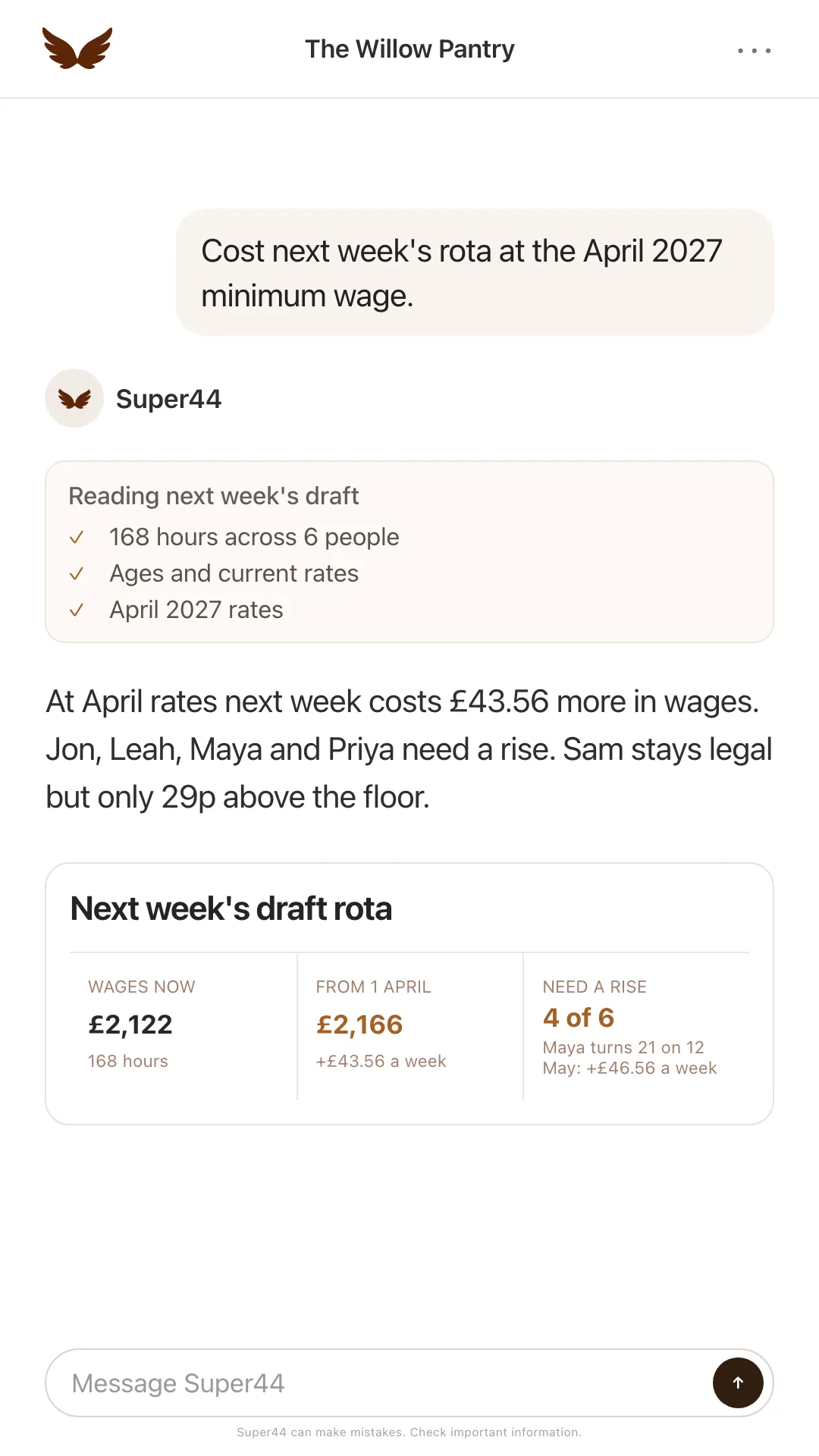
The calculators work in averages per age band. Your rota doesn't: the 20-year-old who turns 21 in May, the 17-year-old on 6 hours one Saturday and 8 the next, the cook on £13.80 who isn't in any band you entered.
In Super44, ask for next week's rota costed at the April rates. It reads every shift on the draft, each person's date of birth and current rate, and gives you the weekly bill at £13.21, £11.27 and £8.31. It names everyone who needs a rise and shows how close your supervisors end up to the floor. Superstaff drafts that rota from roles, availability and approved leave and redrafts it against your sales and next week's weather forecast, so the shifts you cost are the ones you'd run. The rota and time tracking are part of Core at £19 a month for the whole venue, with no per-person fee.
How the calculator works out the cost
Each band's extra wages are its headcount times weekly hours times the gap between today's rate and the new minimum, counted only where the rate sits below it. Everything else rides on that.
- The year is 52 paid weeks. Someone on regular hours is paid through their 5.6 weeks of holiday, so those weeks are already in the wages line.
- Holiday cover is the shifts someone else works while a person is away: 5.6 weeks of their hours at the new rate. Choose "We run short" if you close or trade with fewer people instead. For the holiday pay itself on irregular shifts, the holiday pay calculator works out the rolled-up rate.
- Employer National Insurance is 15% of weekly pay above £96, for staff 21 and over. For under-21s and apprentices under 25 you pay none up to £967 a week. The Employment Allowance takes up to £10,500 a year off your whole bill, so if yours stays under it after April, the National Insurance part costs nothing. Our Employment Allowance guide shows how fast a manager's salary uses it up.
- The pension is 3% of weekly pay between £120 and £967. You have to enrol staff aged 22 and over on more than £192 a week; younger or lower-paid staff can opt in, and then you pay the same 3%.
- National Insurance stays the same in 2027 to 2028. The £96 a week threshold is fixed until 5 April 2028, and Budget 2026 left the National Insurance rates unchanged. The pension thresholds for 2027 to 2028 are still under review at the DWP, so the calculator uses this year's.
Salaried staff need their own check. Divide the salary by 52, then by the hours they really work: an assistant manager on £27,000 for 40 hours a week earns £12.98 an hour, which is under £13.21 from April. GOV.UK's rules count the hours they work beyond their contracted annual hours too.
Before your first April payroll
Run these four checks in March, while there's still time to change prices and pay letters.
Ready for £13.21
- Everyone under £13.71 is on a listInclude supervisors, cooks and anyone paid between the old and new floor, and decide each person's new rate.
- Birthdays are checkedAnyone turning 18 or 21 moves to the higher rate from the first pay period starting on or after their birthday.
- Salaries are divided by hoursAnyone whose salary works out under £13.21 an hour on the hours they really work gets a raise or fewer hours.
- Payroll starts on the right dateThe new rates apply from the first pay period that starts on or after 1 April 2027: Monday 5 April for a Monday weekly payroll.
Frequently asked questions
What is the minimum wage in 2027?
From 1 April 2027 the National Living Wage for workers aged 21 and over is £13.21 an hour, up 50p from £12.71. The rate for 18 to 20 year olds is £11.27, and the rate for 16 and 17 year olds and apprentices is £8.31. The government confirmed the rates on 28 October 2026, accepting the Low Pay Commission's recommendations in full.
How much will the 2027 minimum wage rise cost an employer?
About £920 a year for an employee aged 21 or over on 30 hours a week: £780 in wages plus 15% employer National Insurance and a 3% pension on the extra pay. An 18 to 20 year old on 30 hours costs £655 more, with no employer National Insurance. Paying someone to cover their 5.6 weeks of holiday at the new rates adds about another 11%.
Do I have to give a pay rise to staff already above the minimum wage?
Only if their rate is below the new minimum for their age. A supervisor on £13.50 needs nothing by law, but their gap above the floor shrinks from 79p to 29p. Giving one supervisor on 35 hours the same 50p rise costs about £1,074 a year once employer National Insurance and pension are added.
When do I have to start paying £13.21?
From the first pay reference period that starts on or after 1 April 2027. If your pay month runs from the 1st, the whole of April is paid at £13.21. If you pay weekly from Mondays, the new rate starts on Monday 5 April 2027, because 1 April is a Thursday.
Do tips count towards the minimum wage?
No. GOV.UK says tips, gratuities, service charges and cover charges do not count towards minimum wage pay. The hourly rate itself has to reach £13.21 for staff aged 21 and over, however good the tips are.
Sources
- Restaurant Online: Hospitality faces further wage pressure as National Living Wage set to exceed £13 (Joe Lutrario, 27 October 2026) — UKHospitality chief executive Allen Simpson: "For a labour-intensive sector like hospitality, wage increases of this scale represent a considerable additional burden that many businesses will struggle to absorb." Also: "Industry estimates suggest around 330,000 hospitality jobs are paid at or close to the minimum wage." Checked 6 November 2026.
- GOV.UK: LPC recommendations take the National Living Wage to £13.21 — Published 28 October 2026. From April 2027: £13.21 for 21 and over (3.9%), £11.27 for 18 to 20, £8.31 for 16 to 17 and apprentices, accommodation offset £11.53 a day. "there is still potential to lower the age limit, especially for 20 year olds". Checked 6 November 2026.
- Low Pay Commission: minimum wage rates for 2027 — Published 28 October 2026. The government accepted the Low Pay Commission's recommendations in full. Table of April 2027 rates with every increase at 3.9%: 50p, 42p, 31p, 31p and 43p. Checked 6 November 2026.
- Low Pay Commission: advice to government on 2027 minimum wage rates — Published 28 October 2026. "We recommend that the following rates apply from 1 April 2027". Recommends pausing 18 to 20 alignment with a percentage rise in line with the NLW, because demand for young workers has slowed. Checked 6 November 2026.
- HM Treasury: Budget 2026 — Published 28 October 2026. "On 1 April 2027, the National Living Wage will increase by 3.9% to £13.21 per hour". Also "no increase to the headline rates of income tax, National Insurance contributions, or VAT." Checked 6 November 2026.
- GOV.UK: National Minimum Wage and National Living Wage rates — April 2026 rates: £12.71 (21 and over), £10.85 (18 to 20), £8 (under 18), £8 (apprentice). The apprentice rate applies to apprentices aged under 19, or aged 19 or over and in the first year of their apprenticeship. Checked 6 November 2026.
- Low Pay Commission: The National Minimum Wage in 2026 — April 2026: National Living Wage £12.71, up 4.1%; 18 to 20 rate £10.85, up 8.5%. Checked 6 November 2026.
- GOV.UK: Rates and thresholds for employers 2026 to 2027 — Employer Class 1 National Insurance 15%; Secondary Threshold £96 a week, £5,000 a year; Upper Secondary Threshold for under-21s and Apprentice Upper Secondary Threshold for apprentices under 25: £967 a week, £50,270 a year. "Employment Allowance for 2026 to 2027 is £10,500." Last updated 1 September 2026. No 2027 to 2028 version published. Checked 6 November 2026.
- HM Treasury: Autumn Budget 2024, overview of tax legislation and rates — Section 2.3: the secondary threshold falls from £9,100 to £5,000 a year; "This will take effect from 6 April 2025 until 5 April 2028." Main secondary Class 1 rate rises from 13.8% to 15%; Employment Allowance from £5,000 to £10,500. Checked 6 November 2026.
- GOV.UK: Employment Allowance — Eligible employers can reduce their annual National Insurance liability by up to £10,500 each tax year. Checked 6 November 2026.
- The Pensions Regulator: earnings thresholds — Qualifying earnings for 2026 to 2027: lower level £6,240 a year or £120 a week; earnings trigger £10,000 a year or £192 a week; upper level £50,270 a year or £967 a week. Checked 6 November 2026.
- The Pensions Regulator: work out who to put into a pension — Staff "aged between 22 up to State Pension Age" who earn over £10,000 a year, or £192 a week, must be put into a pension scheme, and "you must both pay into it". Checked 6 November 2026.
- GOV.UK: Workplace pensions, what you, your employer and the government pay — Employer minimum contribution 3%, on earnings between £6,240 and £50,270 a year. Checked 6 November 2026.
- The Pensions Regulator: opting in and joining — Staff who can opt in: "aged 16-21, or state pension age to 74" earning above £10,000 a year, or "aged 16-74" earning above £6,240 up to and including £10,000 a year; they are "entitled to contribution into the pension scheme from their employer." Checked 6 November 2026.
- DWP: review of the automatic enrolment earnings trigger and qualifying earnings band for 2027 to 2028 — Published 3 November 2026 as research and analysis supporting the review of the 2027 to 2028 thresholds, with no figures. Checked 6 November 2026.
- GOV.UK: Holiday entitlement — "Almost all people classed as workers are legally entitled to 5.6 weeks’ paid holiday a year". Checked 6 November 2026.
- GOV.UK: Calculating the minimum wage — Last updated 23 October 2026. "the increase applies to the first pay reference period starting on or after the date of any change." "The same approach applies when a worker reaches a birthday that makes them eligible for a higher minimum wage rate." "Tips, gratuities, service charges and cover charges do not count towards minimum wage pay." Checked 6 November 2026.
- GOV.UK: Working hours for which the minimum wage must be paid — Salaried hours work: "all the excess hours are taken into account when checking that at least the minimum wage rates have been paid." Checked 6 November 2026.
- Low Pay Commission Report 2025 — Executive summary: "NLW increases continue to narrow pay differentials between jobs paid at the wage floor and those paid slightly above it." "Several told us they have reached the limits of how far differentials can be squeezed." Checked 6 November 2026.