VAT on Food and Drink for UK Cafés: What Is Zero-Rated and What Is 20%, Item by Item
Everything eaten in and every hot drink carries 20% VAT. Cold food taken away is mostly zero-rated, but crisps, chocolate biscuits, cans and bottled water are not. Here is the item-by-item table to check your till against, what one wrong button costs a café in a year, and how to price for both.

Alex Riesenkampff
17 November 2026 · 14 min read · Markdown
In a UK café, everything eaten or drunk on your premises carries 20% VAT, and so does every hot drink and any takeaway food you keep hot, heat to order or sell as hot. Cold food taken away is zero-rated, and so are bakes still warm only because they are cooling from the oven, so a £4.80 sandwich keeps all £4.80 when it leaves the shop and £4.00 when it is eaten at your tables. The exceptions are the items HMRC standard-rates wherever they are eaten: crisps, sweets, chocolate biscuits, ice cream, cans, juice and bottled water.
All of this applies once you are VAT-registered, which is compulsory when your taxable turnover for the last 12 months passes £90,000. Below that you charge no VAT on anything. The 28 October 2026 Budget offered no cut to hospitality VAT.
The item-by-item table: what your till should charge
Eat-in is always 20%, so the only column that varies is takeaway: zero for cold food, 20% for anything kept hot, heated to order or on HMRC's always-standard list. HMRC's catering notice puts the eat-in rule in one line: "You must always charge VAT at the standard rate if you make a supply of food and drink for consumption on the premises that it’s supplied in". Your premises include the tables on the pavement outside as well as the room itself.
| Coffee, tea, hot chocolate | 20% | 20% | Hot drinks are always standard-rated |
| Iced latte, iced coffee with milk | 0% | 20% | Coffee and milk drinks are zero-rated when cold and taken away |
| Milkshake | 0% | 20% | Milk drinks, milkshakes included, are zero-rated |
| Fruit smoothie, fresh orange juice | 20% | 20% | Juice and fruit-led smoothies are standard-rated beverages |
| Canned and bottled soft drinks, bottled water | 20% | 20% | Soft drinks and bottled water are always standard-rated |
| Cold sandwich, wrap, salad box | 0% | 20% | Cold takeaway food is zero-rated |
| Toastie, panini, cheese on toast | 20% | 20% | Heated to order |
| Bacon roll, hot sausage sandwich | 20% | 20% | A hot filling makes the whole item hot food |
| Sausage roll or pasty, cooling after baking, sold in a paper bag | 0% | 20% | None of the five hot-food tests met |
| Sausage roll or pasty kept in a heated cabinet | 20% | 20% | Kept hot after heating |
| Hot soup | 20% | 20% | Heated to be eaten hot |
| Croissant, pastry, cake, flapjack | 0% | 20% | Cakes and plain bakery are zero-rated |
| Croissant warmed for the customer | 20% | 20% | Heated to order |
| Millionaire's shortbread | 0% | 20% | HMRC lists it with the zero-rated cakes |
| Chocolate-covered biscuit or shortbread | 20% | 20% | Chocolate-coated biscuits are confectionery |
| Chocolate bar, sweets, cereal bar | 20% | 20% | Confectionery is always standard-rated |
| Crisps | 20% | 20% | Potato crisps are always standard-rated |
| Ice cream | 20% | 20% | Anything designed to be eaten frozen |
| Bag of coffee beans to take home | 0% | n/a | Coffee beans are zero-rated food |
Three lines on that table catch most owners out. The iced latte is zero-rated taken away because HMRC zero-rates coffee and milk drinks, and its food notice says "Cold drinks that are zero-rated in their own right, for example milk and are supplied for off-premises consumption can be treated as zero-rated." A fruit smoothie is the opposite: "fruit and vegetable smoothies are standard-rated", even in a paper cup. A smoothie that is mostly milk or yoghurt can count as a milk drink and be zero-rated taken away. And the millionaire's shortbread on your counter counts as cake, while a chocolate-covered shortbread finger next to it is a 20% biscuit.
Your food and drinks GP should be worked out on the price after VAT, which is what our food GP calculator and drinks GP calculator do. Use this table to pick the rate you type into them.
When hot food is 20% and when it stays zero-rated
Takeaway food that is hot when you hand it over is 20% if it passes any one of HMRC's five tests, and stays zero-rated only if it fails all five. The tests are: heated so it can be eaten hot, heated to order, kept hot after heating, handed over in heat-retaining packaging, or advertised as hot. HMRC adds that "it’s the purpose of the supplier (and not the customer) in heating the food or drink that's the determining factor."
That is the rule behind the bakery exception. A sausage roll that came out of the oven at 11am and is still warm at 11.20 is zero-rated taken away, provided you sold it in an ordinary paper bag and did not call it hot. HMRC's own example ends: "As none of the tests are satisfied, the sale of the pasty is zero-rated."
Put the same rolls under a heat lamp and they are kept hot, so 20%. Chalk "hot sausage rolls" on the board and they are advertised as hot, so 20%. "Freshly baked" on the board is fine; HMRC says it does not count as marketing food as hot.
Two smaller rules come up every day. A sandwich with a hot filling is hot food: "If you sell hot food with an ingredient that’s cold as a single item, the whole supply is standard-rated." And a microwave for customers to use makes the food you sell hot, whether or not you charge for it.
What one wrong button costs a café in a year
On a café taking £2,400 a week, ringing half its cold food the wrong way moves about £67 a week, roughly £3,467 a year, in one direction or the other. Take a café in Leeds. It sells £1,200 of hot drinks a week, £250 of toasties, £150 of cans and water, and £800 of cold sandwiches, salads and cakes, half of which are eaten at the tables.
Rung up correctly, the VAT is £333 a week: a sixth of the £2,000 of standard-rated sales. The £400 of cold food that goes out of the door carries none.
Now suppose the staff press "eat in" by habit. The café hands HMRC £400 a week instead of £333, overpaying £67 a week, about £3,467 a year. That comes straight out of the owner's profit.
Suppose instead they press "takeaway" for everything cold, because it is the default button. The café underpays by the same £67 a week. That looks like a saving until HMRC checks, and a VAT assessment can reach back four years: about £13,867 at this size, plus interest, plus a penalty if HMRC decides the error was careless.
What the eat-in share of your cold food is worth in VAT
Want this worked out for your own venue? Try Super free
Assumes the 20% standard rate, so VAT is one sixth of a VAT-inclusive price, and 52 trading weeks. Hot drinks, toasties, cans, crisps and other items that are 20% either way are left out because the button makes no difference to them. Underpaying by ringing everything as takeaway moves the same 'VAT due' figure the other way.
How HMRC spots the wrong mix, and what it asks for
HMRC compares your share of standard-rated sales with similar businesses, and a share that looks low can bring an unannounced visit and an assessment going back four years. That is what happened to Honey Cake Patisserie and Sandwich Bar in Wandsworth, whose case reached the First-tier Tribunal in 2023.
The HMRC officer told the tribunal she "undertook the visit after HMRC’s systems identified the level of standard-rated sales at the business as being ‘too low’." The shop's records showed about 11% standard-rated. HMRC expected 25% to 35% for a business of its kind. After a two-week self-check, HMRC proposed £24,233 of unpaid VAT for the previous four years, with a careless-error penalty on top.
The owner, Mr Vinni, wrote to HMRC that "certain errors may have arisen in our VAT accounting procedures". He explained that he could only pay the minimum wage and that staff turnover was high. The tribunal for the most part accepted that his staff asked customers whether they were eating in, but noted that before HMRC's checks "information was not readily available at the till to assist the sales staff". It allowed his appeal in part and ordered the assessment recalculated.
staff ask customers whether they intend to eat-in or take-away food that they have purchased
The lesson for a small café is about the till rather than the law. Asking the question is the practice the tribunal accepted, and HMRC's notice says that where you cannot tell at the till "you must keep satisfactory evidence to support a fair and reasonable apportionment." A list of what is 20% beside the screen, and till buttons that apply the rate for you, make the right answer the easy one.
How to set up your till so staff get it right
Set the VAT rate on the item and the dining option, never in a cashier's head: both Square and SumUp let you change the rate automatically when a sale is marked as takeaway. Picture the Saturday queue at a sandwich bar, with a new starter on £12.71 an hour at the till. If the takeaway button is the default, every sandwich eaten at the window seat goes through at 0%. Square's UK help centre describes tax rules that switch off the default VAT by fulfilment method, and "For POS orders, these correspond to your dining options." SumUp's hospitality till lets you "set up different prices and VAT rates for take away orders directly in your product catalogue."
Set your till up once, this week
- Default to eat-inMake 20% the default for every item and add a zero-rate rule for the takeaway dining option, so a missed tap overpays slightly rather than underpays.
- Mark the always-20% itemsHot drinks, toasties, soup, cans, water, juice, fruit-led smoothies, crisps, chocolate biscuits, sweets and ice cream stay at 20% whichever button is pressed.
- One question, one tapStaff ask "eating in or taking away?" once per order and press the button. Ring what the customer tells you; that is the practice the tribunal in the Vinni case accepted.
- Split the meal dealA coffee and a cold sandwich at one takeaway price is two supplies: put the coffee at 20% and the sandwich at 0%, using cost or menu prices to divide it.
- Check the Z report weeklyLook at the share of standard-rated sales. If it drops sharply in a week where nothing changed, ask why before HMRC does.
If your till cannot do this, that is a reason to look at another one. Our guide to choosing a first café till compares the main options on price and setup.
Know your VAT split without adding it up by hand
Super44 reads your till and shows how much of each week's takings was eaten in, taken away and standard-rated, so you can check the mix before the quarter's VAT return rather than after. You ask in your own words, as the owner of this demo café did.
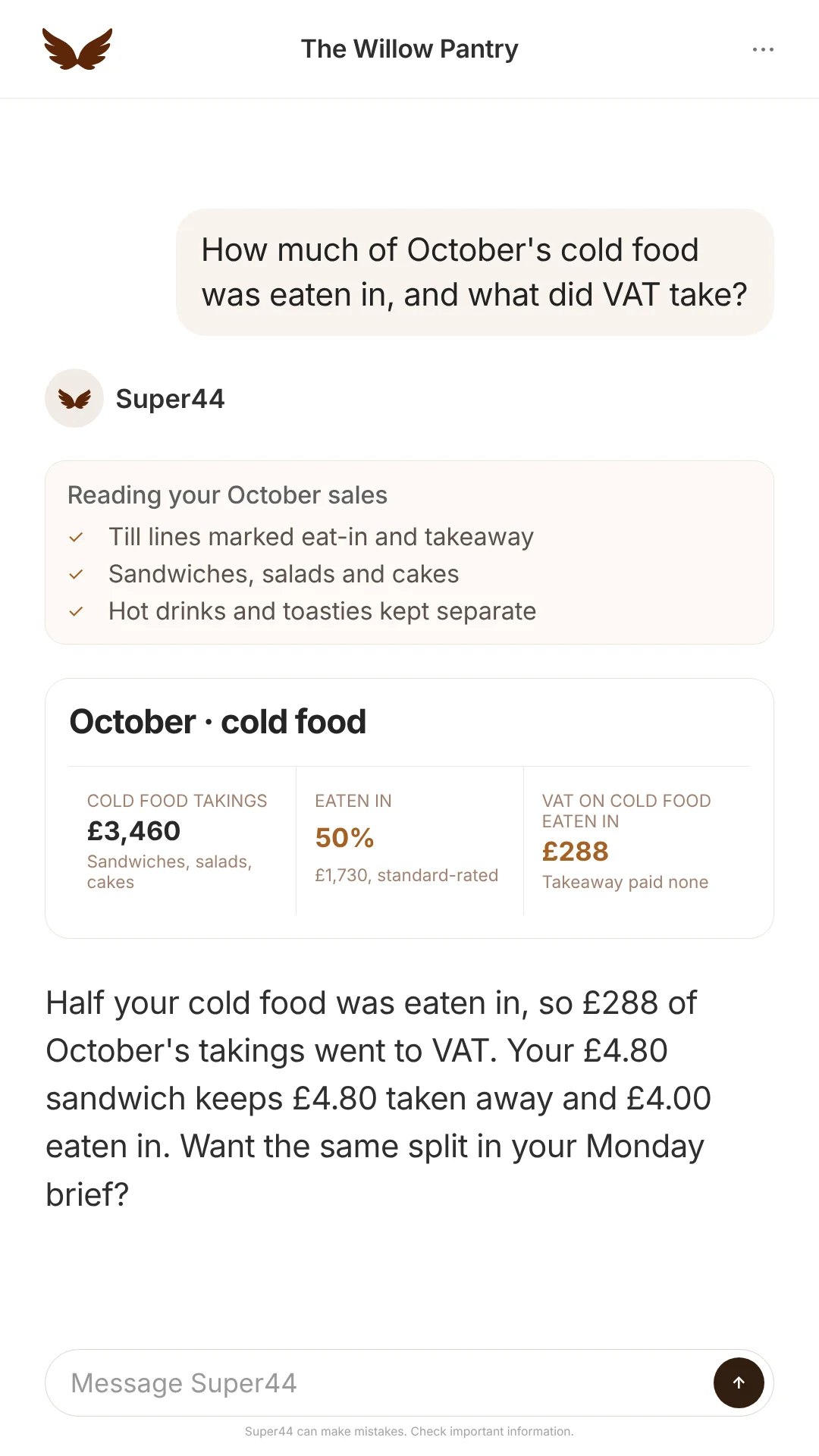
Put that split in your Monday brief and the week your standard-rated share falls for no reason shows up within days, long before HMRC could write about it. The same plan reads your supplier invoices, so each dish's margin is worked out on the price after the right rate of VAT. It is free to start, and connecting your till is from £19 a month.
One price for eat-in and takeaway, or two?
Keep one price and set it so the eaten-in version still makes your margin: a £4.80 sandwich keeps £4.00 at the table, and you would need £5.76 on the board to keep £4.80 there. One price is easy to display, and it spares the person on the till an argument about why sitting down costs more.
Two prices make sense in one situation: most of your sales go out of the door and a few pence decide them. A kiosk by a station or an office lobby, where the customer can see the chain's price next door, is that situation. A neighbourhood café where people sit for an hour is not.
The cost of two prices is goodwill. A customer charged 96p extra to sit down hears a penalty for staying, and the person on the till has to explain HMRC. Most single cafés are better off with one price, a margin that survives the 20%, and the till recording which it was.
Whatever you choose, run the eat-in price through the menu price and GP calculator, which works backwards from your cost to the price you need with VAT included.
Staying under the £90,000 threshold, and the flat rate option
You must register for VAT once your taxable turnover for the last 12 months passes £90,000, and zero-rated takeaway sales count towards that figure even though they carry no VAT. Below the threshold you charge no VAT on anything, which on a busy café's eat-in trade is worth about a sixth of those takings.
Some owners hold their turnover below the line on purpose by closing early or shutting on quiet days. Lubbock Fine, a City accounting firm, reported in March 2026 that some shops and cafés were doing exactly that.
Instead of expanding, firms are making decisions based on how to stay under an arbitrary limit.
Before you close on Mondays to stay under £90,000, remember what registering really costs: VAT on all your standard-rated sales, not only on the extra day. For a café that would land just over the line, staying under can be the right call. For one heading well past it, turning trade away only delays the bill, and our cash flow guide for the first six months shows how to plan the first VAT bills.
Once registered, a café with VAT taxable turnover of £150,000 or less can join the Flat Rate Scheme. You pay a fixed 12.5% of your VAT-inclusive turnover for "Catering services including restaurants and takeaways", with 1% off in your first year, and you cannot reclaim VAT on purchases. The exception is a limited-cost business, whose goods cost less than 2% of turnover or under £1,000 a year: it pays 16.5%. A café buying its own food, milk and coffee will rarely fall into that group, but check before you compare. Because the 12.5% applies to all your takings, a café selling mostly cold takeaway can pay more on it than on normal VAT. Run both sums with your accountant before joining.
Is a VAT cut for cafés coming?
No: the 28 October 2026 Budget offered no reduction in hospitality VAT, so price on 20% for eat-in and hot food. Restaurant Online reported that "today’s Budget offering no reduction in hospitality VAT" left the sector's main ask unanswered.
The #VATsTheProblem campaign, backed by UKHospitality, wants the rate cut from 20% to 10%. Tom Kerridge, chef-owner of The Hand and Flowers in Marlow, has fronted it.
It gives an instant relief. It's a breathing space.
The short summer cut on children's meals, between 25 June and 1 September 2026, has ended, so any reduced-rate buttons added for it should come off your till. Price on today's rates; if a cut comes, the extra room is a bonus.
If VAT turns out not to be your problem and the café is busy without making money, our guide to where a café's takings go works through stock, staff, rent and card fees the same way.
Frequently asked questions
Is there VAT on takeaway food in the UK?
Only on some of it. Every hot drink carries 20% VAT, and so does takeaway food that is kept hot, heated to order or sold as hot, as do items HMRC always standard-rates such as crisps, sweets, chocolate biscuits, ice cream, cans and bottled water. Cold takeaway food such as a sandwich, salad or slice of cake is zero-rated, so a £4.80 sandwich taken away keeps the full £4.80.
Is there VAT on coffee in a UK café?
Yes, 20% on any hot coffee, tea or hot chocolate, eaten in or taken away, so a £3.60 flat white brings in £3.00. A cold iced latte taken away is zero-rated, because HMRC zero-rates coffee and milk drinks served cold for consumption off the premises; drunk at your tables it is 20%. A bag of coffee beans to brew at home is zero-rated.
Do I charge VAT on a toastie or a sausage roll?
A toastie or panini heated to order carries 20% whether it is eaten in or taken away. A sausage roll or pasty sold warm only because it is freshly baked and cooling, in a plain paper bag and not sold as hot, is zero-rated taken away. Keep it in a heated cabinet or advertise it as hot and it becomes 20%.
Should I charge a different price for eat-in and takeaway?
Most single cafés are better with one price set high enough that the eaten-in version still makes your margin. Two prices make sense when most of your trade is takeaway and a few pence decides the sale, such as a station or office kiosk. Either way, the till must record which it was, because the VAT differs even when the price does not.
Do I have to charge VAT if my café turns over less than £90,000?
No. You must register once your VAT taxable turnover for the last 12 months goes over £90,000, and until then you charge no VAT and reclaim none. Count every sale towards the threshold, including the zero-rated takeaway ones, because zero-rated sales are still taxable turnover.
Sources
- HMRC: Catering, takeaway food (VAT Notice 709/1) — Temporary reduced rate for certain children's meals 25 June to 1 September 2026 (banner). Sections 3.1 to 3.3 (premises, apportionment), 4.1 to 4.4 (hot food precondition, five tests, freshly baked exception, examples 1 to 6), 4.6 and 4.7 (single items and meal deals), 2.3 (service charges and tips). Last substantive change 8 June 2026; checked 17 November 2026.
- HMRC: Food products (VAT Notice 701/14) — Sections 3.1 (juice, smoothies), 3.4 (cakes, biscuits, flapjacks, millionaire's shortcake), 3.5 (ice cream), 3.6 (confectionery), 3.7.2 (non-alcoholic beverages; milk, milkshakes, coffee, tea zero-rated; cold zero-rated drinks taken away), 3.8 (crisps). Last updated 8 June 2026; checked 17 November 2026.
- HMRC VAT Food manual: VFOOD7720, coffee, cocoa and chicory — Zero-rating of preparations and extracts of coffee extends to coffee or cocoa based beverages and to coffee beans.
- HMRC VAT Food manual: VFOOD7660, milk and milk-based drinks — Drinks substantially based on milk, such as milkshakes, are zero-rated as preparations of milk; fruit-led smoothies are standard-rated beverages.
- HMRC Compliance Handbook: CH53500, examples of careless behaviour — VAT assessments can only be made for a prescribed accounting period not more than 4 years past, even where behaviour is careless (the 6-year careless limit does not apply to VAT, CH53300).
- GOV.UK: National Minimum Wage and National Living Wage rates — National Living Wage £12.71 an hour for workers aged 21 and over from 1 April 2026.
- GOV.UK: How VAT works, VAT thresholds — Registration threshold more than £90,000; deregistration less than £88,000; Flat Rate Scheme £150,000 or less. Checked 17 November 2026.
- GOV.UK: VAT Flat Rate Scheme, how much you pay — Catering services including restaurants and takeaways 12.5% from 1 April 2022; flat rate applied to VAT-inclusive turnover; 1% first-year discount; limited cost business 16.5%.
- GOV.UK: VAT Flat Rate Scheme, overview — On the scheme you keep the difference between what you charge customers and pay HMRC, and cannot reclaim the VAT on purchases except certain capital assets over £2,000.
- First-tier Tribunal: Vinni v HMRC [2023] UKFTT 911 (TC) — Honey Cake Patisserie and Sandwich Bar, Wandsworth. HMRC visit after its systems found standard-rated sales "too low" (about 11%), against an expected 25% to 35%; proposed assessment £24,233 over four years, later £22,658; careless-error penalty £3,398.70, suspended and cancelled; appeal allowed in part with the assessment to be recomputed. Released 27 October 2023. Source of the Vinni quotes.
- Square Support Centre (UK): Create and edit tax rules — Tax exemption and reduction rules by fulfilment method; for POS orders these correspond to dining options. Checked 17 November 2026.
- SumUp: POS for hospitality — Different prices and VAT rates for takeaway set in the product catalogue; order type switched at checkout. Checked 17 November 2026.
- City AM: UK firms deliberately halting growth to dodge VAT — Lubbock Fine analysis of HMRC data; source of the Jaspal Dhillon (VAT partner, Lubbock Fine) quote. 2 March 2026.
- Restaurant Online: Disappointing Budget for hospitality as pleas for lower VAT fall on deaf ears — The 28 October 2026 Budget offered no reduction in hospitality VAT; the #VATsTheProblem campaign asks for 20% to 10%. 28 October 2026.
- The Staff Canteen: Push everybody to the petition, Tom Kerridge on VAT campaign — Source of the Tom Kerridge (chef-owner, The Hand and Flowers, Marlow) quote. 3 June 2026.