AI Food Photos for Your Menu and Instagram: Improve the Real Plate, Never Invent One
AI can rescue a dark, cluttered phone photo of your real dish in seconds. A dish drawn from nothing is another matter: Deliveroo bans it, Just Eat apologised for it in October 2026, and UK advertising rules judge it like any other picture. Where the line sits for a UK café, pub, restaurant or bakery.

Alex Riesenkampff
3 November 2026 · 19 min read · Markdown
AI is good at fixing a photo of your real dish and dangerous when it draws a dish that does not exist. Deliveroo's menu rules, updated in September 2026, say "AI-generated images are not permitted on Deliveroo" while offering to enhance real photos with cluttered backgrounds, blur or poor lighting. That is the line for any UK café, pub, restaurant or bakery. Use AI to improve the light, background and crop of a photo you took of the plate you serve. Never use it to invent the plate, enlarge it or dress it with food the guest will not get. A generated dish risks complaints, rejected listings and a picture that breaks UK advertising and food law.
A phone photo of a burger under kitchen strip lights looks grey, while an image model will hand you a glossy one in ten seconds. The trouble is that the glossy one is a promise, and the guest checks it the moment the plate lands.
Where the line sits: change the photograph, never the food
Anything that changes how the photograph looks is fair, and anything that changes what the food is crosses the line. Brightening a dim shot, correcting a yellow cast, sharpening a blurry edge, cropping to a square and clearing a dirty napkin out of the background all leave the dish as it is. Adding a sprig of herbs, thickening the cheese pull, doubling the chips or replacing your crumble with a prettier one all change what the guest will receive.
Here is the difference on one real burger, photographed by the venue that serves it.
One burger, three pictures
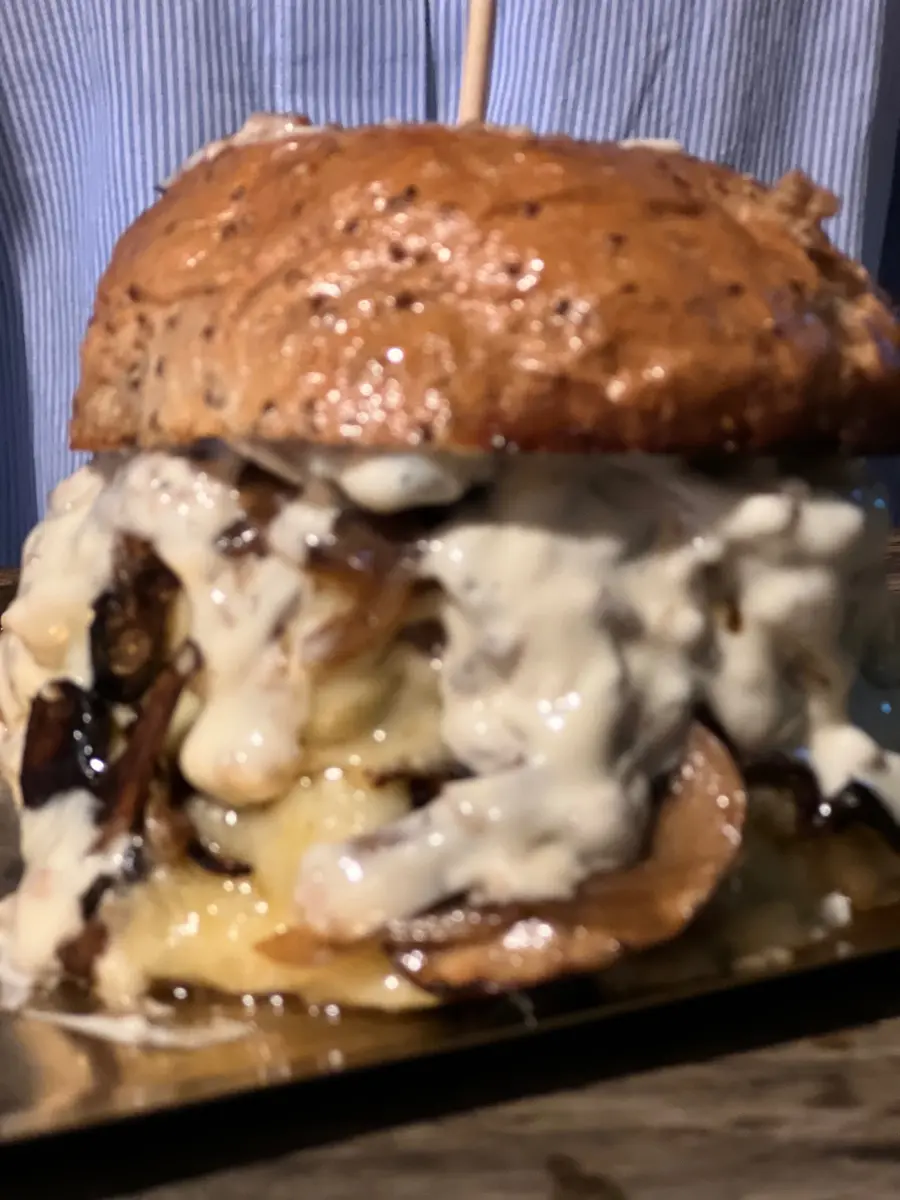 The venue's phone photo
The burger as it left the kitchen: soft focus, glare on the sauce, and a shirt in the background.
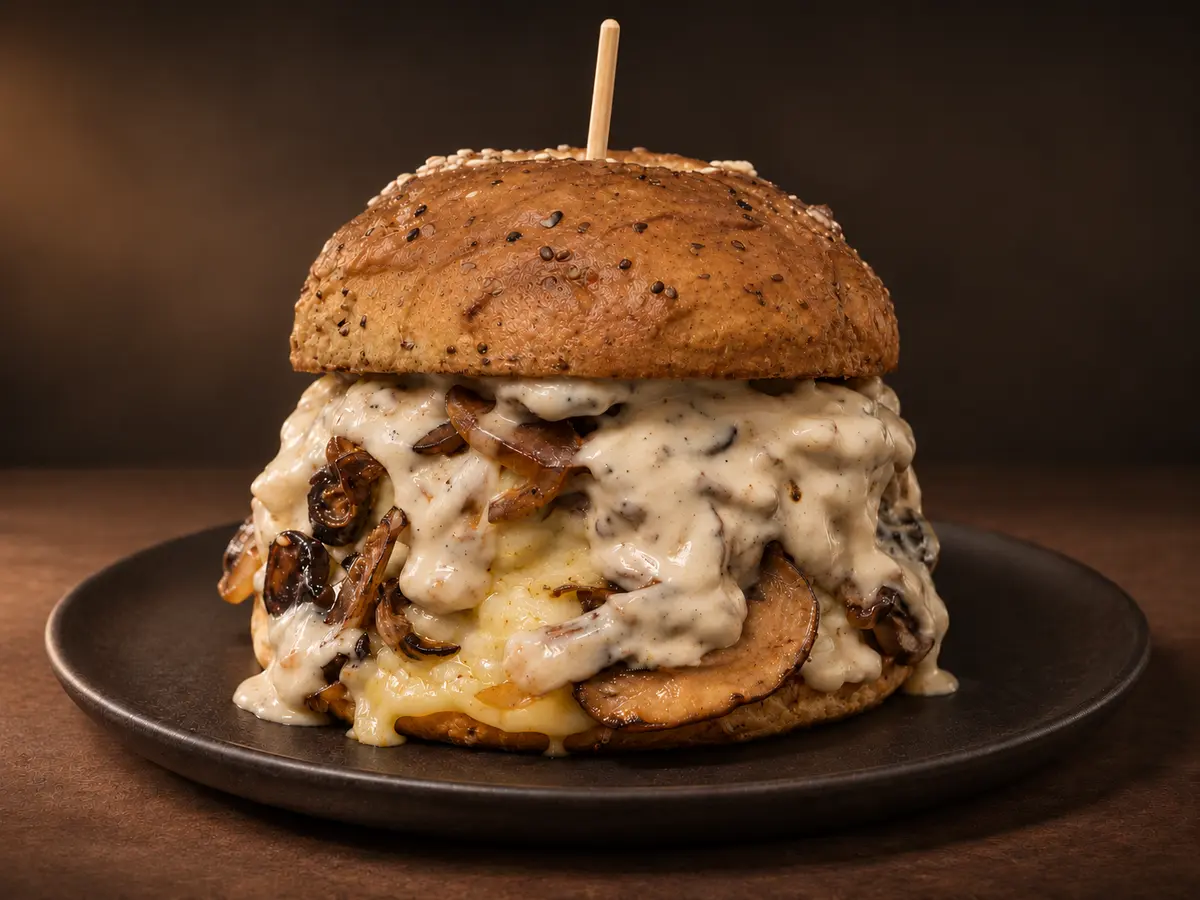 Improved by Super44 from that photo
The same burger, now sharp, evenly lit and on a clean dark background. Every ingredient is the one the kitchen served.
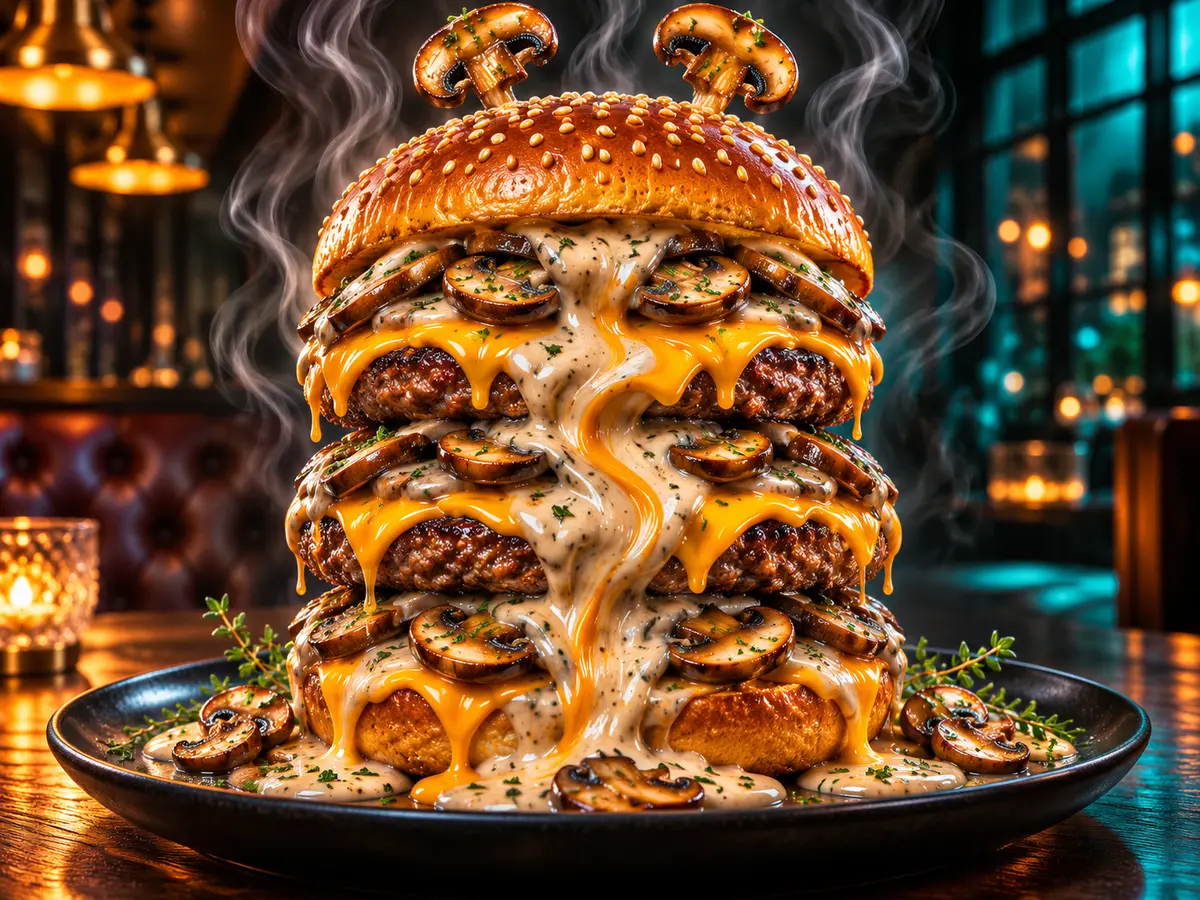 Generated from a description
Made from a description, without the photo. Three patties, a cheddar waterfall and mushrooms on stalks: a burger this kitchen has never cooked.
Super44 made that middle picture from the venue's own photo, and it does the same from a chat message. Send it the photo from your phone, say what to fix, and it works from your plate: its instructions are never to swap in generated food for what you serve.
The ASA's September 2025 guidance on imagery says pictures that give "an inaccurate impression about the product consumers will receive, for example, by featuring the wrong product, including extras, or by exaggerating the quality or size of the product, are likely to mislead." Read that list as a menu of what generative AI does by default. Ask a model for "a pork belly with crackling" and it gives you its idea of one, usually bigger, shinier and more garnished than yours.
| What you do to the picture | Where it sits | Why |
|---|---|---|
| Brighten, fix white balance, sharpen | Fine | The dish is unchanged |
| Crop or reframe for Instagram, a menu or Deliveroo | Fine | Deliveroo crops item images to a square itself |
| Remove background clutter, a stray napkin or a crumb on the rim | Fine, with care | Deliveroo enhances cluttered backgrounds; keep everything on the plate |
| Swap a messy table for a plain surface | Fine for social, check platform rules | Deliveroo asks for a clean background but rejects "obvious signs of image editing" |
| Add garnish, sauce or sides you do not serve | Crosses the line | The ASA treats extras the customer will not receive as misleading |
| Enlarge the portion or fill out the plate | Crosses the line | The ASA upheld a portion-size complaint against Birds Eye in 2016 |
| Generate the dish from a description | Crosses the line | Banned on Deliveroo; shows a dish nobody cooked |
Allergens are the quiet risk in the bottom rows. A generated dessert that shows a scatter of nuts you never use, or a bun with sesame seeds yours does not have, sends a guest with an allergy the wrong signal before they read the menu. A picture that contradicts your written allergen information is one more conversation the server has to correct.
Re-plating sits near the line, and the test is the same. An edit can tidy a plate or show one slice of a whole cake, provided the guest would recognise what arrives. The pasta below was gathered into a neater nest with its sauce worked through. The cake slice was drawn from a photo of the whole cake, keeping its three sponge layers and two cream layers. Both still show what the venue serves. The generated versions do not.
Truffle pasta: re-plated, then invented
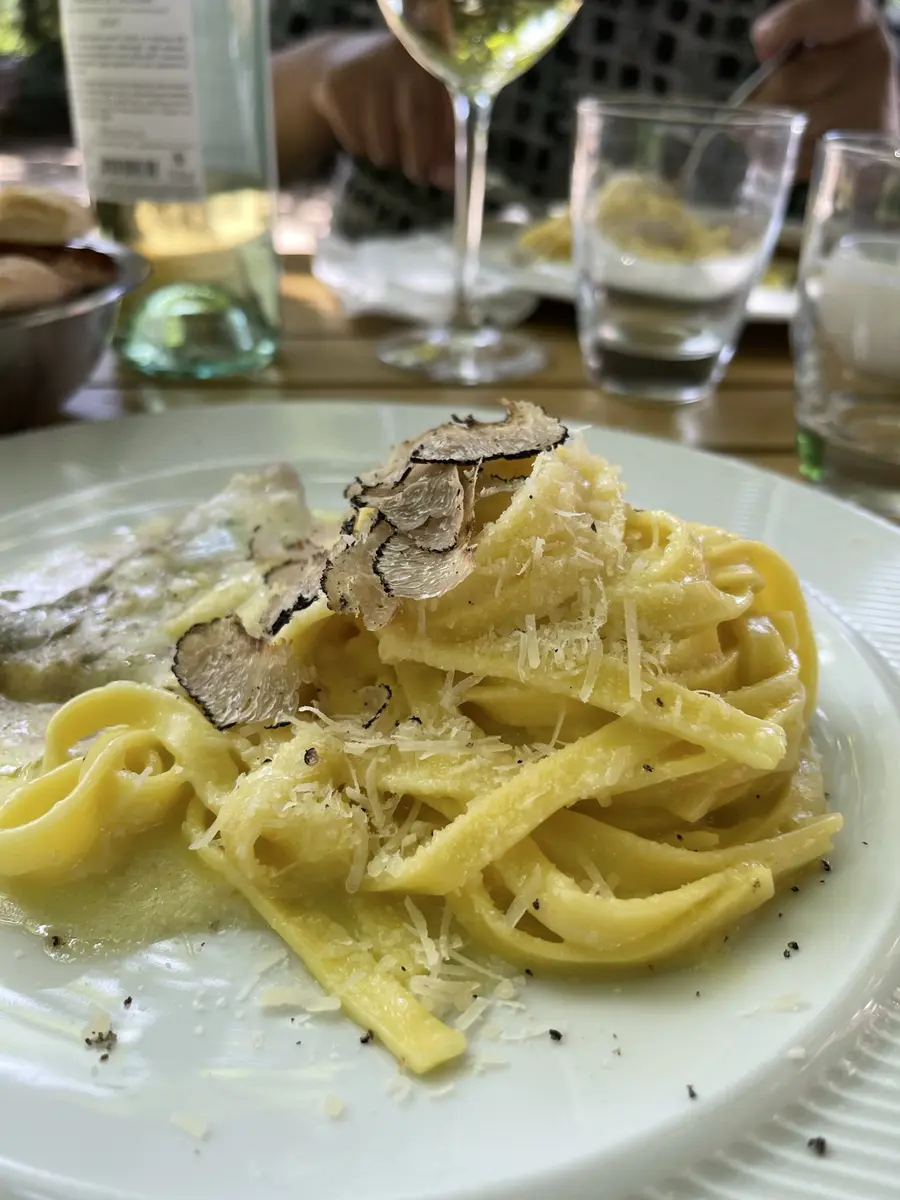 The venue's phone photo
Taken at the table: glasses, a bottle and other diners behind the plate, with a mound of sauce and cheese beside the pasta.
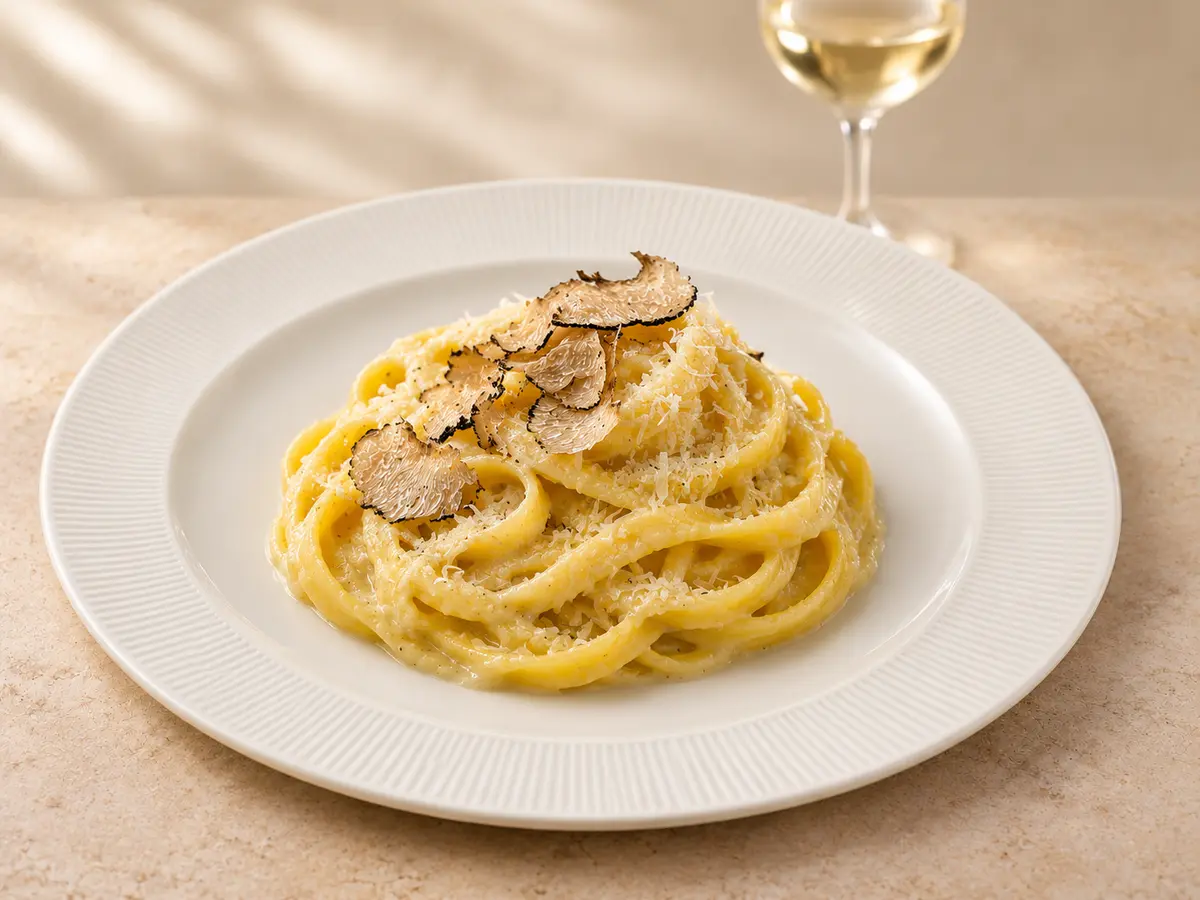 Improved by Super44 from that photo
The same pasta, cheese and truffle, plated neatly in one nest on a clear table, ready for the menu.
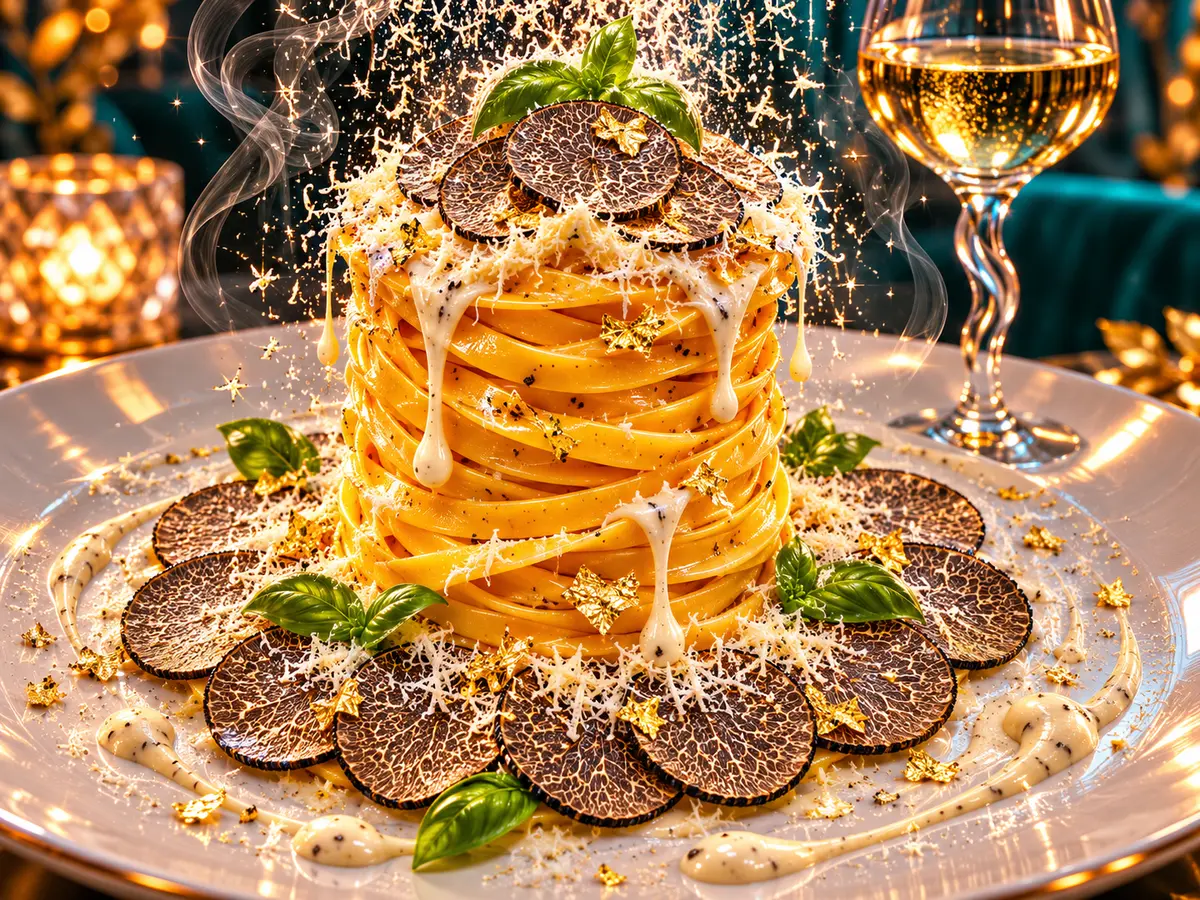 Generated from a description
Made from a description: a pasta tower, gold leaf, basil and a ring of perfect truffle discs.
Caramel hazelnut cake: one slice, then a fantasy
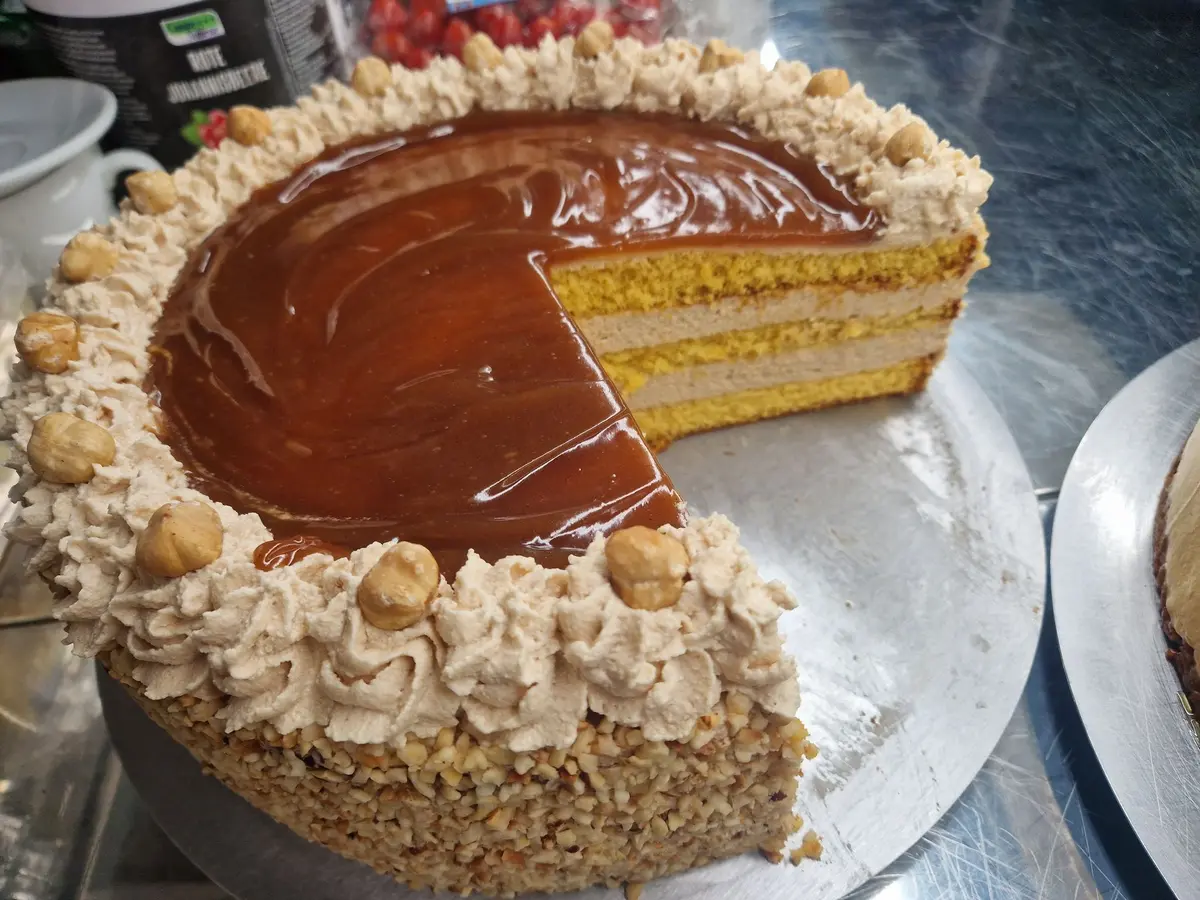 The venue's phone photo
The whole cake on the kitchen counter, with packaging and a mug in the background.
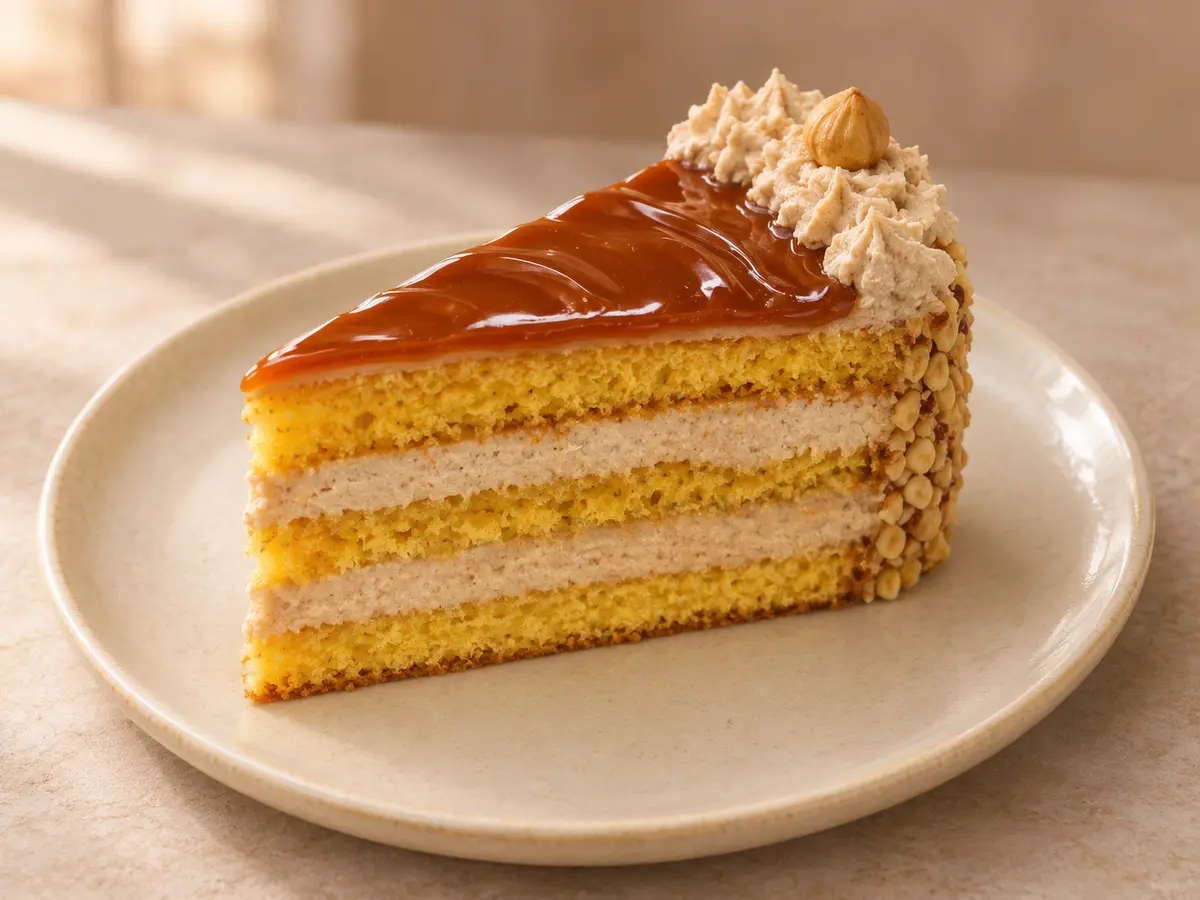 Improved by Super44 from that photo
One slice of the same cake on a clean plate: three sponge layers, two cream layers, caramel top and chopped hazelnuts, exactly as the guest receives it.
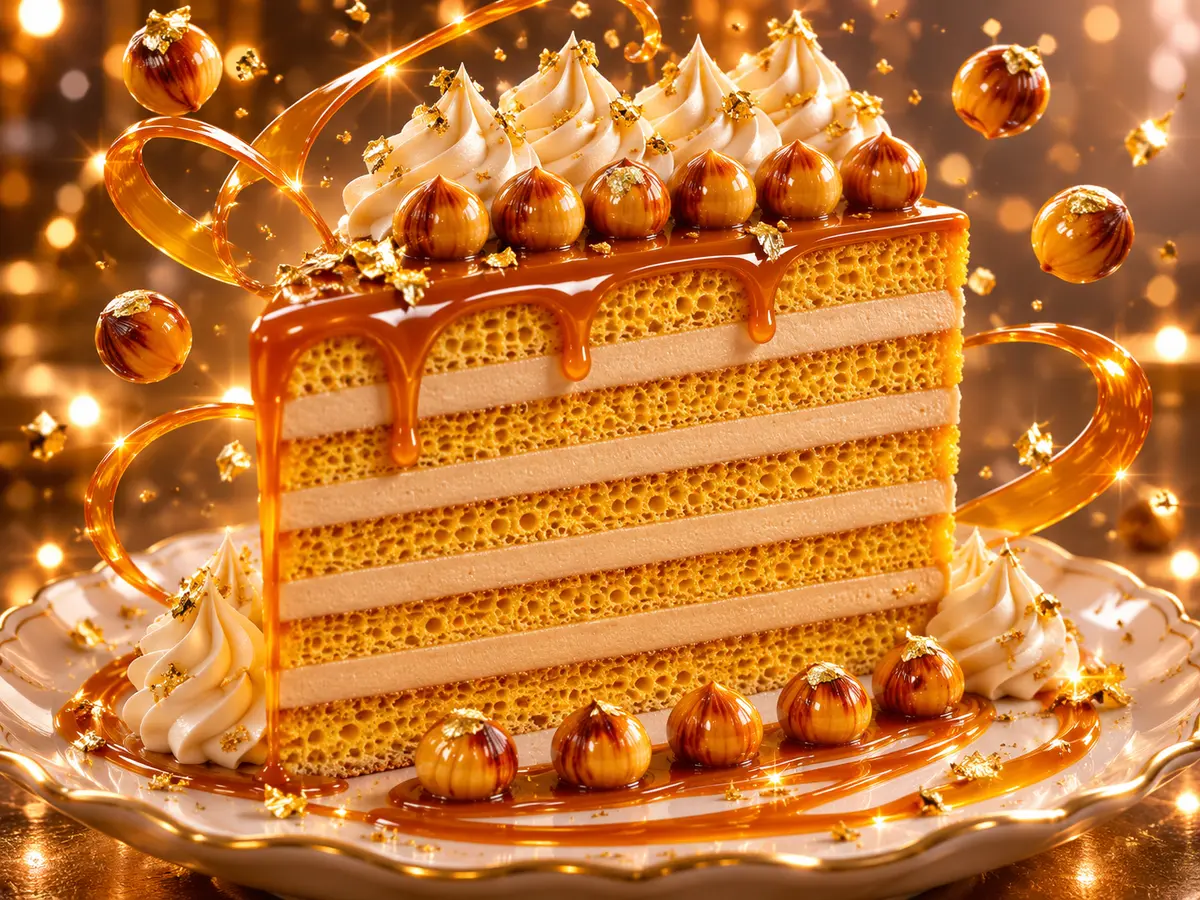 Generated from a description
Made from a description: extra layers, floating hazelnuts and caramel in mid-air.
What UK rules say about a food picture on your own Instagram
UK advertising rules apply to your own posts, and they judge the picture by the impression it gives, not by how it was made. The CAP Code has applied since 2011 to a business's own website and to "non-paid-for space online" under its control, which the ASA says includes "a brand’s X (formerly Twitter) feed, Facebook page, Instagram profile, YouTube channel and any other social media channels". A café's grid of dish photos is likely to count as marketing in that sense, even if you never paid to boost a post.
The ASA does not care whether a camera or a model produced the image. Its May 2025 guidance on AI disclosure is direct: "Whilst the CAP and BCAP Codes do not contain AI-specific rules, our existing rules apply regardless of how content is generated, edited, or targeted." Its June 2026 note on AI goes further for anyone tempted to blame the tool: "If an AI tool produces something problematic, the advertiser remains responsible for any output used in their ads."
The ASA has been clear about plates for years. Its 2016 ruling against Birds Eye found a TV ad's pan and bowl shots "appeared to contain more pasta and mushrooms when compared to one real-life serving", and it told the company "not to exaggerate the portion sizes of their products in future." The September 2025 guidance uses a plate of stew, potatoes and rice as its example. That picture "is likely to mislead if the customer will only receive the stew".
You should usually either show the item as customers will receive it, or make it explicitly clear which element(s) any stated price relates to.
Food law reaches the same place by a different road. Section 15 of the Food Safety Act 1990 makes it an offence to publish an advertisement that "falsely describes any food" or "is likely to mislead as to the nature or substance or quality of any food". It adds that an accurate statement of the food's composition does not prevent a court finding the offence. Above both sits the Digital Markets, Competition and Consumers Act 2024, in force since April 2025. Its test for a misleading action includes "an overall presentation which is likely to deceive the average consumer", and it says such a presentation "may be deceiving even if the information it contains is true." GOV.UK's guidance notes the CMA and the courts can now fine traders up to 10% of worldwide turnover. That figure is a ceiling, and the test of an overall presentation applies to a corner café as much as a chain.
Small print does not rescue a misleading picture either. The ASA's May 2025 guidance says "disclosure alone is very unlikely to mitigate the harm caused by a fundamentally misleading message." Writing "AI image" under a dish you cannot serve leaves you with a dish you cannot serve.
Deliveroo has drawn the line, and Just Eat learned why
Two of the delivery apps UK venues sell through have each met this problem. Deliveroo bans AI-generated images outright and asks partners to "only upload authentic images of the food or products you sell", while offering image enhancement for real photos with eligible faults such as a cluttered background, blur or poor lighting. Its rules also reject "obvious signs of image editing" and tell partners "Don’t use collages or overly photoshopped images". Deliveroo wants the real plate, cleaned up.
Just Eat learned the other half of the lesson in public. In October 2026, Restaurant Online reported that it had paused an AI menu-imagery tool trialled to help smaller independent restaurants. The tool had produced, among other things, "fried eggs and sausages floating in a glass of cola" for what was meant to be a breakfast soda, sushi rolls filled with cheese and wine glasses holding chunks of watermelon. A Just Eat spokesperson said: "We’re sorry for any inaccurate images that have been posted. We’ve paused rolling this out while we further develop the tool to ensure it best serves our partners and customers."
We want partners on our platform to show photos that accurately reflect their dishes so that our customers can be confident in what they are ordering and happy when their food arrives.
A national platform trialled that tool, and the images still went out wrong. A busy owner reviewing a generated picture at the end of a double shift has less chance of catching a cheese-filled maki.
How guests react when they spot it
Guests notice, and the reaction can be harsher than the offence. In July 2026, NBC Bay Area reported that Grind and Unwind, a new San Francisco café and bar, drew bad reviews and graffiti after putting AI-generated pictures of its menu in the window. Lyndsey Lozano, who opened it with her husband, described the response: "A lot of people were like ‘If that’s what your food looks like, I don’t want to eat there.’" The café took the sign down and put its own pastries in the window instead.
The UK version of the argument played out near Macclesfield in October 2026. Kristen, landlady of the Church House Inn in Sutton, near Macclesfield, answered criticism of the pub's AI images in a social media statement reported by Brit Brief. She was frank about why a small pub reaches for the tool, describing days "often 16 hours a day, seven days a week".
Firstly, yes, we sometimes use AI images to help promote our menus and special offers. We're not trying to hide that, and we're certainly not trying to deceive anybody.
Her statement also names the exact mechanism that trips up honest owners: "9 times out of 10 we do use images of our own food but when AI puts it in to a poster with wording or a message the image changes." By her account, the pictures usually start as photos of the pub's own food, and the tool changes them on the way to a poster. Her own test is the right one, too: "We WOULD NOT put out an advert for our food that we could not replicate." The practical lesson is to check every finished poster against the plate, because a model asked to lay out text around your photo may quietly repaint the food.
What Instagram and Google do with an edited picture
The platforms where your guests look also reward the real thing. Google's Business Profile photo guidelines say a photo should have "no significant alterations or excessive use of filters. In other words, the image should represent reality." Your profile photos sit next to photos guests took of the same dishes, so the comparison is made for you.
Meta labels AI content it can detect. Its policy page says it adds an "AI info" label "when we detect industry standard AI image indicators or when people disclose that they’re uploading AI-generated content." Since a September 2024 update, the label for content "only modified or edited by AI tools" sits in the post's menu, while Meta "will still display" the label "for content we detect was generated by an AI tool". A light retouch of your own photo is therefore unlikely to put a visible tag on the post, while a generated dish may well carry one. An edit that re-renders the whole picture can sit in between, so expect the label now and then.
Detection is imperfect in both directions. In June 2024, TechCrunch reported that former White House photographer Pete Souza had a real photo tagged, which he suspected followed a change to Adobe's cropping tool. "What’s annoying is that the post forced me to include the ‘Made with AI’ even though I unchecked it," he told TechCrunch. That was under the older "Made with AI" wording, before the September change, but it is a reason to keep edits light and keep your originals.
What to do with the photos you have this week
Start with the camera you own and a ten-minute habit, not with a generator. Photograph each dish at the pass in daylight or near a window, on the plate and surface you serve it on, the moment it is finished. Then use AI for the jobs a photographer's editor would do: light, colour, sharpness, background and crop. Deliveroo's own enhancement targets faults such as a cluttered background, blur, poor colour saturation and poor lighting, which makes it a good benchmark for how far "improve" can go.
Quick decision helper
Can I post this food picture?
Did the picture start as a photo of a dish you serve, taken in your kitchen?
When you ask an AI tool to edit, tell it what must not change. The default behaviour of most image models is to make food look better, which is the opposite of what you need. A brief like the one below keeps it to the photograph.
Improve my food photo without changing the dish
Edit the attached photo of a dish we serve. Improve only the photograph:
- correct the brightness and white balance so it looks like daylight
- sharpen slightly if it is blurred
- tidy the background (remove clutter, napkins, crumbs off the plate rim)
- crop to [square / portrait 4:5 / landscape 16:9] with the whole plate in frame

Do not change the food in any way. Keep the exact portion size, ingredients,
garnish, sauce, sides, plate and arrangement. Do not add steam, shine, extra
toppings or anything that is not in the original. If you cannot make a change
without altering the food, leave that part as it is.
Then put the result next to the original before it goes anywhere. That one comparison catches the swapped garnish, the plumped-up portion and the poster that redrew your pie.
In Super44 the same job is a chat message. Send the photo, or refer to one you have already saved, and say what to change and what to keep. Its instructions tell it never to substitute generated food for your own products, and you see every version before you use it. These are the kinds of request that work well:
Dish photo requests to send Super44
Here's tonight's cheeseburger. Make it look like a studio shot: brighter,
even light, natural warm colour and a plain dark background. Keep the burger
exactly as it is: same bun, same fillings, same size, nothing added.

The Sunday roast photo I sent came out yellow under the kitchen lights. Fix the
white balance so it looks like daylight, and leave the food alone.

Crop the flat white photo from yesterday to a 4:5 Instagram post with the whole
cup in frame.

Put my four best-selling cakes from my saved photos in one grid for an
Instagram Story, with our logo above them.
Whatever you ask for, glance at the result next to your original before it goes out. If anything on the plate looks different, say so and Super44 will try again from the original.
When a generated image is fine, and when to change this advice
Generated artwork is fine when nobody could take it for a dish. A drawn poster for a live music night, a seasonal pattern behind your Christmas menu or a cartoon of the pub dog on a chalkboard promises nothing about what is on the plate. The test from the ASA's September 2025 guidance is "the overall impression given in the ad", so an illustration that reads as an illustration carries no promise about portion or garnish. The risk returns the moment the artwork looks like a photo of something you sell.
Two situations deserve a second thought. The first is a dish you have not cooked yet: a new menu launching next week. Cook one, photograph it and post that, even if it is a test plate, because a generated preview sets the expectation the real one has to meet. The second is a platform listing with no photos at all. A plain listing loses something, but Just Eat's apology shows that the generated fix can cost more than the gap it fills.
Two kinds of evidence would change this advice. One is an ASA ruling that finds a clearly labelled AI food image acceptable, which its 2025 guidance on disclosure makes unlikely. The other is a delivery platform reversing its stance and accepting generated dish images. Until then, the safest picture of your food is a photo of your food, and AI's job is to make that photo look as good as the plate does.
If you are designing the menu itself, our comparison of AI menu makers covers which tools build a menu from your own photos and which write the descriptions. And before you decide which dishes deserve a photo at all, the evidence in menu engineering beyond the matrix shows that a photo helps most when the dish's name is already clear. For the Google side, our guide to Google posts for restaurants covers what to post each week, with a photo taken at the venue. To turn a handful of those photos into a whole week, a week of posts and a Reel from your own photos plans it day by day.
Frequently asked questions
Is it illegal to use AI-generated food photos for my restaurant?
Not in itself. The ASA says its advertising codes contain no AI-specific rules. What is banned is a picture that misleads: the CAP Code covers your own website and Instagram, and the Food Safety Act 1990 makes misleading food advertising an offence. An AI-drawn dish that does not match the plate you serve is the easiest way to break both.
Can I use AI to edit my own food photos?
Yes, for light, colour, sharpness, background clutter and cropping. Deliveroo enhances real menu photos for exactly those faults while banning AI-generated ones. Stop at the food itself: adding garnish, enlarging the portion or swapping in a better-looking dish changes what the guest will receive.
Do I have to label AI images on Instagram?
Meta adds an "AI info" label when it detects industry-standard AI signals or when you disclose AI use. Since September 2024, content only edited with AI gets the label in the post menu, while AI-generated content shows it on the post. A label does not fix a misleading picture: the ASA says disclosure alone is very unlikely to cure a fundamentally misleading message.
Can I put an AI-generated food photo on Deliveroo or Just Eat?
Not on Deliveroo, whose rules say AI-generated images are not permitted and ask for authentic images of the food you sell. Just Eat paused its own AI image trial in October 2026 and said it wants partners to show photos that accurately reflect their dishes. Photograph the real dish.
What about AI images that are obviously illustrations?
A drawn poster for a quiz night or a cartoon of your dog on the chalkboard misleads nobody about a dish, and the rules care about the impression a picture gives. Keep anything that looks like a photograph of a plate you sell honest to that plate, and keep illustrations obviously illustrations.
Sources
- Deliveroo Help Centre: How to upload your own photos in Menu Manager — Updated 2 September 2026. "AI-generated images are not permitted on Deliveroo"; image enhancement for eligible issues such as cluttered background, blurry image and poor lighting; "obvious signs of image editing" and "overly photoshopped images" as rejection reasons. Checked 3 November 2026.
- Restaurant Online: Just Eat apologises for surreal AI generated food images — Published 21 October 2026. Just Eat paused an AI menu-imagery tool trialled with smaller independents; spokesperson quotes on inaccurate images and accurate photos.
- ASA/CAP: A picture says a thousand words. Avoiding misleading imagery in ads — CAP News, 11 September 2025. Images exaggerating quality or size likely to mislead; the plate of stew, potatoes and rice example.
- ASA/CAP: Remit: Own websites — The CAP Code has applied since 2011 to a company's own website and non-paid-for space online under its control, including an Instagram profile.
- ASA ruling on Nomad Foods Europe Ltd t/a Birds Eye — June 2016. TV ad upheld for exaggerating the portion size of a pasta ready meal compared with one real-life serving.
- ASA/CAP: Disclosure of AI in advertising — CAP News, 29 May 2025. No AI-specific rules; existing rules apply however content is generated; disclosure alone very unlikely to cure a misleading message.
- ASA/CAP: AI and deepfakes, four things advertisers need to know — CAP News, 11 June 2026. The advertiser remains responsible for any AI output used in its ads.
- Food Safety Act 1990, section 15 — Offence to publish an advertisement that falsely describes food or is likely to mislead as to its nature, substance or quality; an accurate statement of composition does not preclude the offence.
- Digital Markets, Competition and Consumers Act 2024, section 226 — Misleading actions include an overall presentation likely to deceive the average consumer, which may deceive even if the information it contains is true. In force 6 April 2025.
- GOV.UK: What businesses need to know about unfair commercial practices — Updated 3 December 2025. The CMA and the courts can fine non-compliant traders up to 10% of worldwide turnover.
- Google Business Profile Help: Manage your Business Profile photos and videos — Photo quality guideline: no significant alterations or excessive use of filters; "the image should represent reality". Checked 3 November 2026.
- Meta: Our approach to labeling AI-generated content and manipulated media — Published 5 April 2024 with updates. "AI info" label from July 2024; from September 2024 moved to the post menu for content only edited by AI, still displayed for content detected as AI-generated.
- TechCrunch: Meta is tagging real photos as Made with AI, say photographers — Published 21 June 2024. Pete Souza's photo labelled after an Adobe cropping change.
- NBC Bay Area: SF restaurant receives backlash after using AI for menu pictures — Published 19 July 2026. Lyndsey Lozano, who runs Grind and Unwind with her husband, San Francisco, on the response to an AI-made window menu. US case.
- Brit Brief: Landlady defends pub's use of AI images after backlash — Published 12 October 2026. Reports a social media statement by Kristen, landlady of the Church House Inn, Sutton, near Macclesfield.