Social Media for Restaurants, Cafés and Pubs With No Time: A Week of Posts and a Reel From Your Own Photos
Five photos already on your phone are enough for three Instagram posts, one Google post and a short Reel. A worked week for a UK café, pub or restaurant, how often to post, what Instagram rewards, and the rules that apply to a venue's own posts.

Alex Riesenkampff
4 November 2026 · 17 min read · Markdown
A café, pub or restaurant with no time for social media needs five photos and one sitting a week. Five photos already on your phone can carry three Instagram feed posts, one Google post and one short Reel built from the same stills, and Buffer's analysis of about 2.1 million posts found accounts posting three to five times a week grew followers more than twice as fast as those posting once or twice. The rest of this guide is that week, made end to end for a demo café, with what each post is for, when it goes out, and the decisions that stay with you.
The demo is a made-up café we will call Daybreak Coffee. It is not a real venue and the photos are described rather than shown, so you can swap in your own.
Why your own phone photos are the right material
Your own photos are what Instagram is built to reward, so they are the place to start. Instagram's creator team said in April 2024 that "when we find two or more identical pieces of content on Instagram, we will only recommend the original one." Reposting a supplier's shot or a viral clip puts you on the losing side of that rule. A slightly wonky photo of your own croissants does not.
Instagram also makes Reels less visible when they are low-resolution or watermarked, according to Adam Mosseri's May 2023 explainer, which also names Reels "that have already been posted on Instagram" as a reason for reduced reach. In practice, that means three habits. Shoot in good light, at your phone's normal camera setting. Export videos without another app's logo stamped in the corner. Never repost a clip someone else already put up.
Guests do look. Barclaycard's May 2023 survey of 2,000 UK adults who use social media and eat out found that "The average person now spends 40 minutes reading up on restaurants via social media before booking." The same survey put Facebook (43%) and Instagram (41%) as the platforms they use most for that research. The survey was commissioned by a bank and covers social media users only, so treat it as a sense of scale. Still, it means somebody deciding between you and the place next door is probably scrolling your grid.
Which platforms deserve your hours is a separate question. Where diners find you weighs word of mouth, Google and TikTok by guest type, and this guide assumes you have settled on Instagram with Facebook alongside.
How often to post: three feed posts and a Reel is enough
Three feed posts and one Reel a week is the default this guide recommends for a venue without marketing help. It sits in the middle of what the data shows and inside what one person can keep up.
Buffer's 2025 study of about 2.1 million Instagram feed posts from roughly 102,000 accounts found that posting three to five times a week rather than once or twice can more than double the follower growth rate, with median reach per post about 12% higher. Buffer is honest about the limit: "we can’t tell whether frequent posting causes growth, or whether naturally fast-growing accounts just happen to post more." The study covers posts sent through Buffer's own tool, and it excludes Stories.
| 1–2 | +0.12% | baseline |
| 3–5 | +0.26% | +12% |
| 6–9 | +0.44% | +18% |
| 10+ | +0.66% | +24% |
Most small accounts post less than that. Later's analysis of posts published through its tool in 2023 found accounts with up to 10,000 followers averaged two feed posts a week. Instagram itself has not published an official number.
Going past five a week brings smaller gains for a lot more work, and the work has to come from somewhere. In a small venue that somewhere is usually you after close, or a member of staff during service. Three good posts beat seven rushed ones you resent.
Judge it on the right numbers, too. Socialinsider's 2025 figures, from 67.5 million posts by brand accounts with 1,000 to 1 million followers, put the average Reel engagement rate at 0.52%. A Reel that gets a handful of likes from a few hundred followers is normal. Look instead at whether people mention a post when they come in, or ask for the thing you showed.
The worked week: five photos at a demo café
The whole week below comes from five photos taken on one Tuesday morning at Daybreak Coffee. The café, its offer and its prices are fictional. The structure is the part to copy.
The five photos:
- A. A flat white and a butter croissant on the counter, shot from above, in window light.
- B. A tray of croissants coming out of the oven at 7am.
- C. A close-up of a croissant torn in half, showing the layers.
- D. Sam, the barista, pouring latte art. Sam has agreed to be on the account.
- E. The empty window seat at 8am, before the first customer.
Before any of them goes out, fix the photograph and leave the food alone. Brightening a dim shot, correcting the yellow cast of kitchen lights, cropping to a 4:5 post and clearing a napkin out of the background all leave the croissant as it is. A dusting of icing sugar it never gets, a pastry plumped up by an editor or a generated croissant in its place all change what the guest receives. The ASA's September 2025 guidance on imagery warns against "Images which give an inaccurate impression about the product consumers will receive", including pictures that add extras or exaggerate size or quality. Put each edit next to the original before you post it. Using AI on your food photos shows where that line sits on three real dishes.
One photo session gives five posts across five days, each with a different job, so no guest sees the same picture twice in a row.
| Monday | Google post (offer) | A | Tells people searching nearby about a dated offer | Tuesday mornings: flat white and butter croissant, £5.50, 8 to 11am. |
| Tuesday | Instagram carousel | B, C, A | Shows the work behind the product | This is 7am. The croissants go in before we unlock the door. |
| Thursday | Instagram Reel | B, C, D, A, E | Reaches people who do not follow you yet | Text on screen: 6:40am. The oven goes on. |
| Friday | Instagram post | D | Puts a face to the place | Sam has poured roughly a thousand of these. Still checks every one. |
| Saturday | Instagram post | E | Practical: hours and an invitation | Open 8am to 4pm today. The window seat goes first. |
The Google post goes first because it does a different job from the rest. It sits on your Business Profile where someone searching "coffee near me" sees it, and as an offer it ends on the date you set. Google archives update posts after six months unless a date range is set, which is how a Christmas menu ends up showing in February. Google posts for restaurants covers the post types, how often to post, and the rule that rules out drinks deals.
The Tuesday carousel is the one most venues skip, and it is often the most interesting. Guests rarely see a kitchen at 7am. Friday's photo of Sam gives the account a person, and Saturday's is plain information that saves someone a phone call. On the day, photo E with today's hours on it also works as a Story.
If you want an AI assistant to draft the captions, give it the photos, the week and your voice in one go. Here is a prompt that plans a week like this one. For a wider set of prompts for menus, reviews and rotas, see the hospitality prompt library.
Turn five photos into a week of posts
I run [venue name], a [café / pub / restaurant] in [town]. Attached are five photos from this week.
This week is about: [one thing, e.g. our Tuesday breakfast offer, £5.50, 8 to 11am].
Plan one Google post (offer), one Instagram carousel, one Reel made from the stills, and two single Instagram posts, Monday to Saturday.
For each: which photo or photos, the day, what the post is for, and a caption under 60 words.
For the Reel: the order of the stills, about 2 seconds each, and a few words of on-screen text per still.
Write like we talk to regulars at the counter. No hashtag walls, no exclamation marks, no emojis unless I ask.
Do not invent prices, dates, awards or ingredients I have not given you.
Making the Reel from five stills
A Reel does not need video. Five stills at about two seconds each, with a few words of text on each, make a 10 to 15 second Reel that suits a busy owner and suits how Instagram ranks.
Adam Mosseri said in January 2025 that "The top three signals that matter most for ranking are watch time, likes and sends", which favours a short Reel people watch to the end over a long one they abandon. Instagram has allowed Reels of up to three minutes since that same month, when Mosseri announced: "Starting today, you can upload Reels to Instagram up to three minutes long." The extra length is there if you need it, and a venue rarely does.
Build the Daybreak Reel in about the time it takes to drink a coffee
- 1Order the stills as a storyOven tray (B), the torn croissant (C), Sam pouring (D), the finished pair (A), the window seat (E). Morning to opening.
- 2Add one line of text per still6:40am. The oven goes on. / Torn while still warm. / Sam, third coffee of the day. / Yours, Tuesdays, £5.50. / Doors at 8.
- 3Keep it vertical and full-screenCrop to a tall frame so nothing important sits at the very top or bottom, where Instagram puts its buttons and caption.
- 4Choose music you are allowed to useUse Meta's Sound Collection or no music at all. Your PPL PRS licence covers the speakers in the venue and stops there.
- 5Export clean and post it yourselfNo editing-app watermark. Write a caption that says what and when, and pin the Reel to your grid for the week the offer runs.
Demo venue. The text lines are examples to adapt.
Music trips up more venues than anything else in a Reel. PPL says it does not license "Social media services that enable the upload of content by the general public", naming YouTube, Facebook, Instagram and TikTok. Meta's Sound Collection offers "over 14,000 music tracks from established composers and songwriters" for videos on Facebook and Instagram, which is the safe default for a business. What the PPL PRS music licence covers explains the in-venue side.
One feature to ignore for now: trial Reels, which show a Reel to non-followers first, were opened in July 2025 to accounts with at least 1,000 followers and a public profile. Plenty of independents sit below that, and nothing in this week depends on it.
The three decisions that stay with you
Whoever drafts the captions, three decisions belong to the owner: what the week is about, which photo leads, and what never gets posted. Get those right and the drafting is the easy part.
First, what the week is about. Pick one thing: an offer, a new dish, a reopened garden, a quiz night. A week with one subject is easier to plan and easier for a guest to remember. Pete Marshall, licensee of the Kings Arms in Bexleyheath, told the Morning Advertiser in 2022 that "Social media is very much a big tool to setting the tone of who you are." His other point is the reason to pick one subject: "you’ve got to know your audience and tailor your information to the audience you’re trying to attract". A week aimed at office workers looks different from one aimed at Saturday families.
Second, which photo leads. The lead is the photo that does the most work on its own. Daybreak leads with the croissant tray because the week is about breakfast; the latte art waits for Friday. If you cannot pick a lead, the week probably has two subjects.
Third, what never gets posted, which is the decision with legal weight. The ASA says the CAP Code "covers some material" on a business's own social media channels, so a venue's own Instagram post promoting its food or drink is advertising under the CAP Code. Three things follow:
- The photo must show what the guest gets. The ASA's September 2025 guidance on imagery says that "When assessing whether an ad is likely to mislead, the ASA will consider the entire ad, and the overall impression given in the ad." That includes filters. A burger photographed with sides that do not come with it is a problem; a real burger in good light is not.
- Drinks posts have their own rules. CAP Code rule 18.16 says "People shown drinking or playing a significant role must neither be nor seem to be under 25." The ASA's guidance on under-25s adds that this applies to images a venue chooses to share from its own events. A pub's Friday-night crowd shot needs a second look before it goes up.
- People need to have agreed. A recognisable face on a business account is a person's image being used to sell. Ask before a face goes on the account, keep a note of the answer, and accept a no. Take extra care with children; the safest default is to keep them out of the frame.
Before anything goes out
- One subjectThe week is about one thing, and the lead photo shows it.
- Real foodEvery dish looks as a guest will receive it, with no sides or garnish it does not come with.
- Prices and datesEvery price, time and date matches the till and the board.
- People agreedEveryone identifiable has said yes, and nobody shown drinking is or looks under 25.
- Your own mediaNo reposted clips, no watermarks from other apps, music from Meta's Sound Collection or none.
- Drinks deals off GoogleAlcohol offers stay off your Google posts, which do not allow promotions for alcohol.
When to change the plan
Change the week if Google rather than Instagram brings most of your guests, or if drinks, staff or a sudden rush change what you can post.
- If most guests find you through Google, put the Google post first and Instagram second. A neighbourhood restaurant that fills from Maps searches gets more from a fresh weekly Google post, a complete profile and answered reviews than from a fourth Instagram post. Where diners find you helps you work out which kind of venue you are.
- If you run a drinks-led pub, plan around food, events and people. Google posts do not allow alcohol deals, and the CAP Code's alcohol rules apply to everything on Instagram. Quiz night, the Sunday roast and the new chef are easier weeks than a cocktail offer.
- If nobody on the team wants to be on camera, leave people out. Photos of food, the room and the board are enough for a good week. Staff should never feel that appearing online is part of the job.
- If one post goes unexpectedly big, protect your regulars first. A rush of people who came to film rather than to eat is a cost to a small venue, as the Paris wine bar in our discovery-channels guide found. Post less for a while rather than more.
Some businesses decide social media is not worth it. In 2018 JD Wetherspoon closed the social media accounts of all its 900 pubs, and chairman Tim Martin told Restaurant Online: "I don’t believe that closing these accounts will affect our business whatsoever". A national chain with a high-street presence in every town is not an independent café. Still, the decision is a legitimate one if the hours are better spent behind the bar.
The evidence that should reverse this plan is simple. Give it eight weeks. If nobody mentions a post, no one asks for the thing you showed, and the hours are coming out of service or your sleep, drop to one post a week plus Google. If guests start quoting your posts back to you, keep going. For what a fuller marketing effort should cost when you are ready, see restaurant marketing budget benchmarks.
Making this week in Super44
Super44 can make and publish the whole week from one chat, and nothing goes out until you approve it. Super44 publishes Instagram feed posts, carousels of 2 to 10 photos, Reels and Stories, can schedule each one from a minute to 30 days ahead, and posts the Google offer on Core or during the trial.
The Daybreak week, made in Super44
- 1Send the photos and the subjectUpload the five photos and say what the week is about: the Tuesday breakfast offer, £5.50, 8 to 11am.
- 2Ask for the touch-upsBrighter, even light, natural colour, a 4:5 crop and a plain background. Super44's image instructions are to change only what you asked for and never to treat an edit as permission to change the food, prices or branding, and you see every version before you use it.
- 3Get the draftsCaptions in your voice, the carousel order, a branded offer graphic with your saved logo and your exact text, the Google offer and a short Reel from up to three of your stills, such as the oven tray, the torn croissant and the finished pair. For all five stills, build the Reel by hand as above.
- 4Approve and scheduleEach Instagram post arrives as an approval card showing the exact image, caption and time; approve it and it goes out when you chose, up to 30 days ahead. The Google offer is shown to you in chat with its exact text and goes up when you say yes.
- 5Add the Story on the daySaturday's window seat as a Story with today's hours. Stories need an Instagram Business account and take one image or video.
Demo venue. Instagram and Google are connected once, with the owner's own login.
The touch-up step is the one to watch, so here it is on a real burger rather than the demo café's croissants.
A merchant's burger, before and after a Super44 touch-up
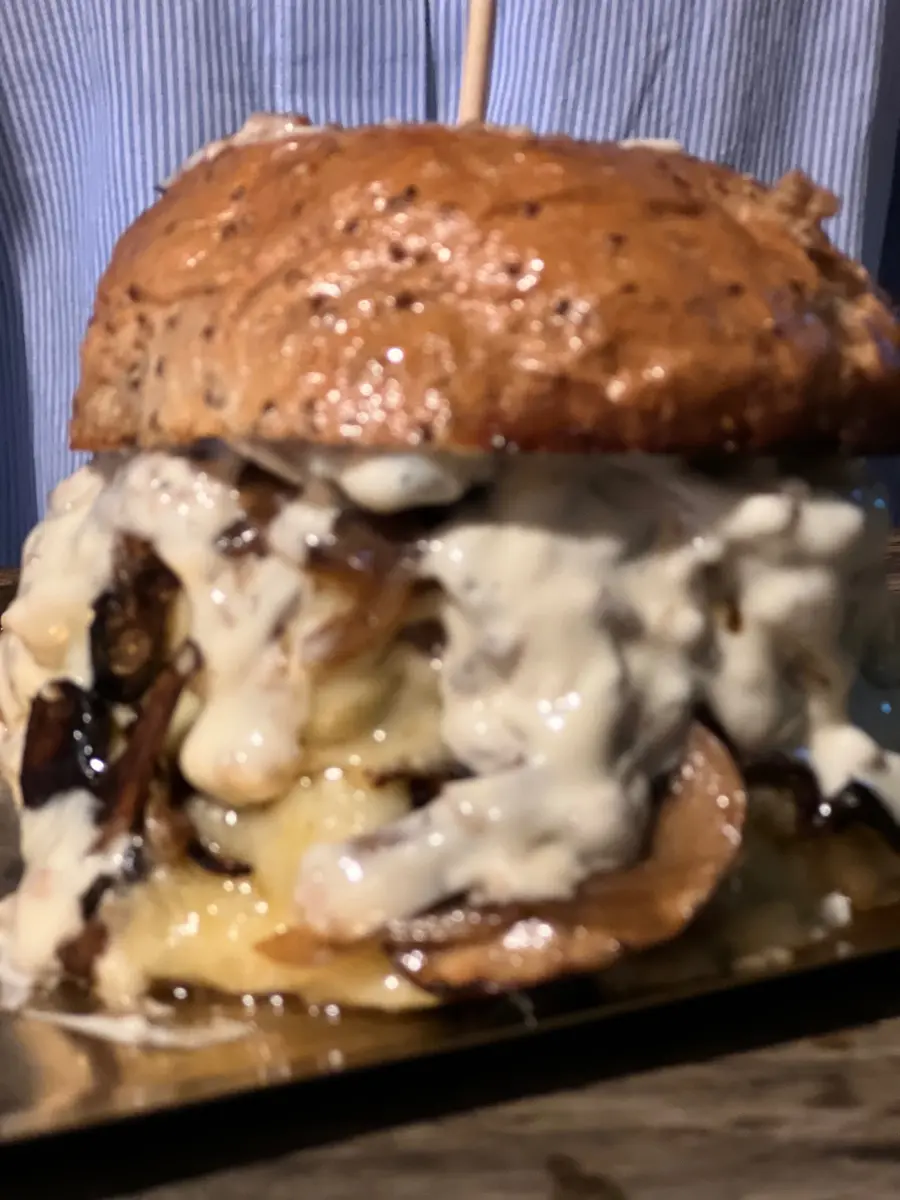 The venue's phone photo
Soft focus, glare on the sauce and a shirt in the background.
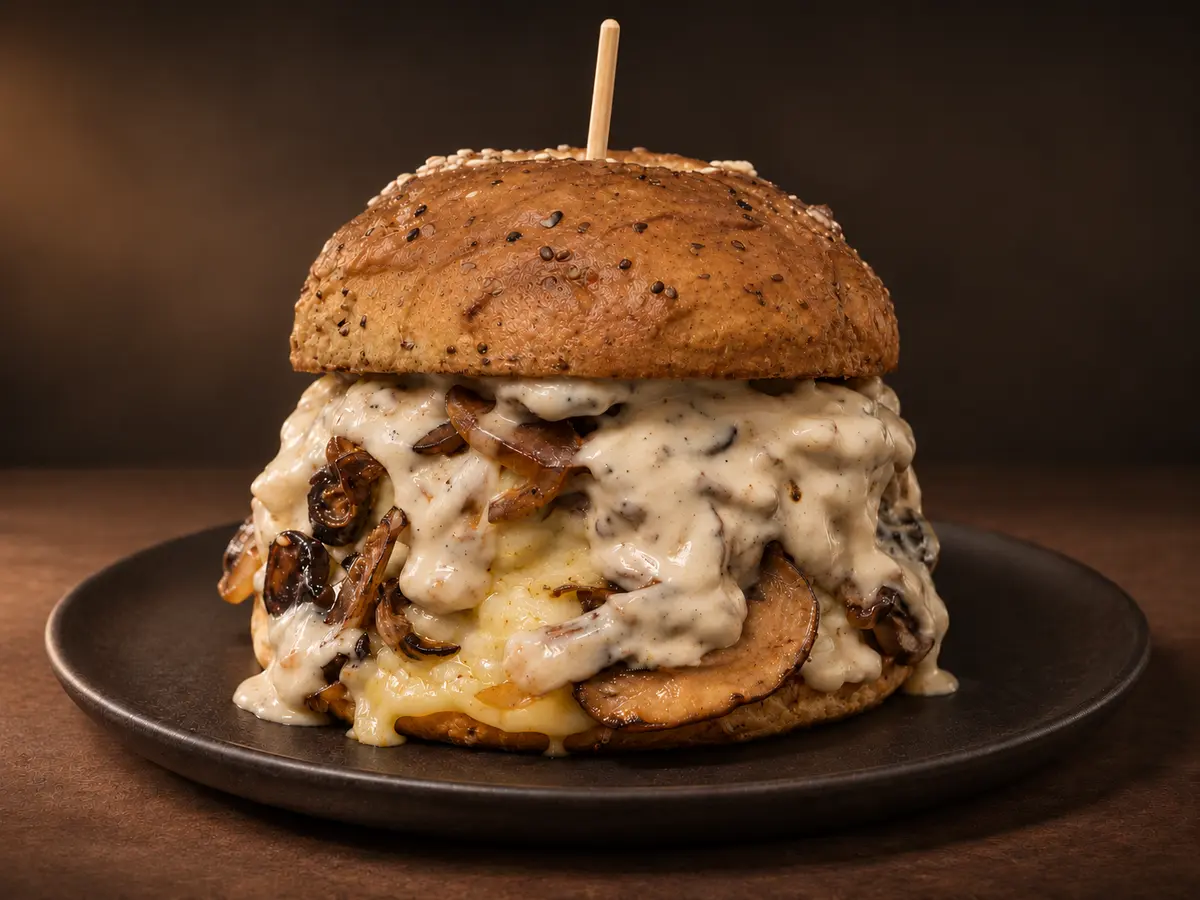 Improved by Super44 from that photo
The same burger, sharp and evenly lit on a clean background, with every ingredient the one the kitchen served.
The improved photo is where a post starts. Ask Super44 to turn it into a poster or a square post with your offer on it, such as "Tuesday breakfast, £5.50, 8 to 11am", with your saved logo in the corner and your brand colours. Its image instructions are to keep the text you supply exactly as written, prices and spelling included, and to follow your logo and brand guidance. They also tell it never to invent prices, offers or credentials. The same picture can become the Google offer, the carousel cover and the closing frame of the Reel, so the week looks like one venue made it.
New graphics can follow your own style too. Super44 checks the recent posts on your venue's public Instagram once a week, and while that check is fresh it uses the layouts, type and colours it saw there as a guide for a new poster or menu graphic, without reusing those photos. Your own instructions and saved brand colours come first.
Connecting Instagram and Google costs nothing. Video has a daily allowance: three clips a day of up to 15 seconds on the free Starter plan, and 10 on Core or 30 on Plus at up to 90 seconds each. Google posts are included on Core and during the trial, and the free plan covers your first one. Super44 does not add music or stickers, does not edit a post once it is live, and posts nothing you have not approved: a card for each Instagram post, and your go-ahead in chat for Google, which can be a standing one such as posting your specials every week. Five photos from this morning are enough to start.
Frequently asked questions
How often should a small restaurant or café post on Instagram?
Three feed posts and one Reel a week is a realistic default for a venue with no marketing help. Buffer's study of about 2.1 million posts found three to five posts a week grew followers more than twice as fast as one or two, while Later found accounts under 10,000 followers averaged two feed posts a week in its 2023 data. Instagram itself publishes no official number.
Do I need professional photos for my restaurant's Instagram?
No. Instagram said in 2024 that it recommends the original when it finds identical content, and it makes low-resolution or watermarked Reels less visible, so clear, well-lit photos you took yourself are the right material. What matters is that the photo shows the dish as a guest will receive it, because the ASA judges a food image on the overall impression it gives.
Can I use popular songs in my pub's Instagram Reels?
Be careful. Your PPL PRS licence covers music played in the venue, and PPL says it does not license uploads to social media services such as Instagram, Facebook and TikTok. Meta's Sound Collection offers over 14,000 tracks of royalty-free music for videos on Facebook and Instagram, which is the safe default for a business account.
How long should a restaurant Reel be?
Keep it short: 10 to 20 seconds is plenty for five stills with a line of text on each. Instagram has allowed Reels of up to three minutes since January 2025, but watch time is one of its top three ranking signals, so a short Reel watched to the end does more than a long one people leave halfway.
Do I need staff permission to post photos of them on social media?
Ask, and keep their answer. A venue's account is a business using someone's image, so treat their permission as theirs to give. The simplest practice is to ask each person before their face goes on the venue's account, accept a no without discussion, and never make it a condition of the job.
Can Super44 post to Instagram and Google for my venue?
Yes, once you connect each account. Super44 publishes Instagram feed posts, carousels, Reels and Stories, schedules them up to 30 days ahead, and posts Google offers, events and updates on Core or during the trial. Every Instagram post waits for your approval on its card, Google posts go up once you approve the exact text in chat, and its touch-ups are instructed to leave the food as the kitchen served it, so check each version against your original before you approve it.
Sources
- Instagram for Creators: Helping creators find new audiences (recommendations and originality) — Published 30 April 2024. When Instagram finds identical content it will only recommend the original; accounts that repeatedly post others' content lose recommendation eligibility.
- Instagram: Instagram Ranking Explained, by Adam Mosseri — Published 31 May 2023. Reels made less visible for low resolution or watermarks, and when they have already been posted on Instagram.
- Social Media Today: Instagram shares algorithm insights for 2025 — Published 22 January 2025. Reports Adam Mosseri naming watch time, likes and sends as the top three ranking signals.
- Social Media Today: Instagram officially expands Reels length to 3 minutes — Published 18 January 2025. Mosseri announcing three-minute Reels.
- Social Media Today: Instagram expands access to trial Reels — Published 13 July 2025. Trial Reels available to creators with at least 1,000 followers and a public account.
- Buffer: How often should you post on Instagram? — Published 13 August 2025. About 2.1 million feed posts from roughly 102,000 accounts sent through Buffer, Stories excluded. Weekly follower growth and median reach per post by posting frequency; correlation only.
- Later: How often to post on Instagram — Updated 8 March 2025, using posts published through Later between January and October 2023. Accounts with up to 10,000 followers averaged two feed posts a week.
- Socialinsider: 2026 Instagram organic benchmarks — Dated 20 February 2026. 67.5 million posts from 579,000 brand accounts with 1,000 to 1 million followers; Reels averaged a 0.52% engagement rate on 2025 values. All industries, not food-specific.
- Barclays: Diners dish out more dough at Instagrammable restaurants — Barclaycard press release, 14 June 2023. OnePoll survey of 2,000 UK adults who regularly use social media and eat out, May 2023. 40 minutes of social research before booking; Facebook 43% and Instagram 41% as research platforms.
- Morning Advertiser: How can I use social media to promote my pub? — 17 August 2022. Interview with Pete Marshall, licensee of the Kings Arms, Bexleyheath.
- ASA: Remit, social media — The CAP Code covers some material on a company's own social media channels.
- ASA: A picture says a thousand words, avoiding misleading imagery in ads — Published 11 September 2025. The ASA judges the overall impression of an image, filters included; images giving an inaccurate impression of the product, including extras or exaggerated size or quality, are likely to mislead.
- ASA: CAP Code section 18, alcohol — Rule 18.16 on people shown drinking being or seeming under 25; rule 18.2 on confidence and popularity.
- ASA: Alcohol, featuring under-25s — An advertiser's own social media pages are covered by the CAP Code, including user-generated content it chooses to share.
- PPL: Other online licences — PPL does not license social media services that let the public upload content, such as YouTube, Facebook, Instagram and TikTok.
- Meta: Music for videos on Facebook and Instagram — Sound Collection: over 14,000 royalty-free music tracks for videos on Facebook and Instagram.
- Google Business Profile Help: Create and manage posts on your Business Profile — Update, offer and event posts; posts older than six months archived unless a date range is set.
- Google Business Profile Help: Prohibited and restricted content — Names alcohol as a restricted product; posts should not display deals, coupons, pricing or other promotions for restricted products.
- Restaurant Online: JD Wetherspoon closes social media accounts for all of its 900 pubs — 16 April 2018. Tim Martin, chairman of JD Wetherspoon, on closing the group's accounts.