Café profit software in the UK (2026): the tools that read your till and show profit
Your till records sales, not costs. Eight options a single UK café would shortlist to see profit, from a free spreadsheet to a group platform averaging £150 to £200 a site, with which tills each reads, what it needs from you first and what one site pays.

Alex Riesenkampff
8 November 2026 · Updated 13 November 2026 · 15 min read · Markdown
Your till knows what you sold yesterday. Until you type in what each item or ingredient costs, it can't tell you what any of it cost to make. To see profit instead of sales, something has to bring in your ingredient costs from supplier invoices and recipes and your labour from the rota, then set both against the till. For a single café, Super44 is the pick. It reads any till, costs each dish from your supplier invoices and runs the rota for £19 a month on Core, under half Brikly's £39 and about a seventh of Jelly's £129. The same plan replies to your Google reviews and posts to Google and Instagram. A spreadsheet does the sums for nothing if you keep it up; MarketMan prices in dollars, Tenzo says its customers average £150 to £200 a site, and Nory publishes no price.
These are the eight options a single-site café in the UK would shortlist; in the US, our restaurant profit software comparison covers Toast, Square and Clover in dollars. Accounting software such as Xero isn't on the list: it gives you last month's profit once the bills are entered, and the question here is what a dish or a shift makes.
Who publishes this, and what connects us to it
Super44 publishes this page and is one of the eight entries. Nobody pays to be listed. Super44 reads sales from Square, Lightspeed, Epos Now, SumUp and other tills, and staff hours from Deputy and RotaCloud, so a café on one of those systems can use us alongside its own reports.
| A spreadsheet | Any size, if someone keeps it up | Any; you type the sales in | Every invoice price, every recipe, and the hours from the rota | £0 on Google Sheets | The number from the last time you updated it |
| Your till's own reports | Any venue on that till | Its own sales only | Unit costs or costed recipes you type in and keep current | Square Plus £69; Lightspeed Core £149; SumUp POS Pro £49 ex VAT | A dashboard you open |
| Brikly (CostingBrik) | One to five sites | Square, SumUp POS Pro | Recipes; invoices forwarded or scanned. Rota module listed as coming soon | £39 (£19 per extra site); 30 days free | Margin alerts when an invoice moves a price |
| Jelly | One site to groups, hotels, caterers | Square, Lightspeed, Epos Now, Toast | Invoices by photo, email or supplier link; Jelly sets up suppliers and recipes. No rota listed | £129 plus a quoted setup fee; Lightspeed surcharge from £15 | Supplier price notifications, live GP |
| Super44 | Single independent venues | Whichever till you use; if it is not connected yet, we connect it | Gmail for invoices, your recipe sheet, the rota in Superstaff, Deputy or RotaCloud | £19 Core, inc. VAT; free to start | A plain-English brief at 8 with one or two things to change |
| MarketMan | Independents to chains | Square, Lightspeed, Toast, Clover | Recipes, scanned invoices and stock counts. No rota listed | $249 Starter, 12-month commitment; £79 as an add-on to Square Plus | Recipe costs and actual against theoretical reports |
| Tenzo | Independents to large groups, run from head office | Most widely used POS systems | A separate inventory tool for food cost and a rota app for labour | From £55; customers average £150 to £200 per site | Scheduled reports; daily numbers on the manager's phone |
| Nory | Two or more sites, in its own words | All major POS, including Epos Now, Lightspeed, Square, Toast | Your rota, stock and payroll moved into Nory | Does not publish | Forecasts, schedules and a live P&L |
What your till can't tell you about profit
A till's sales report records what sold and what it took. Profit needs two more numbers: what each dish cost to make and what the staff on shift cost. Tenzo, which sells reporting that sits on top of tills, puts it plainly in its own FAQ: "Your POS only knows what happens at the till."
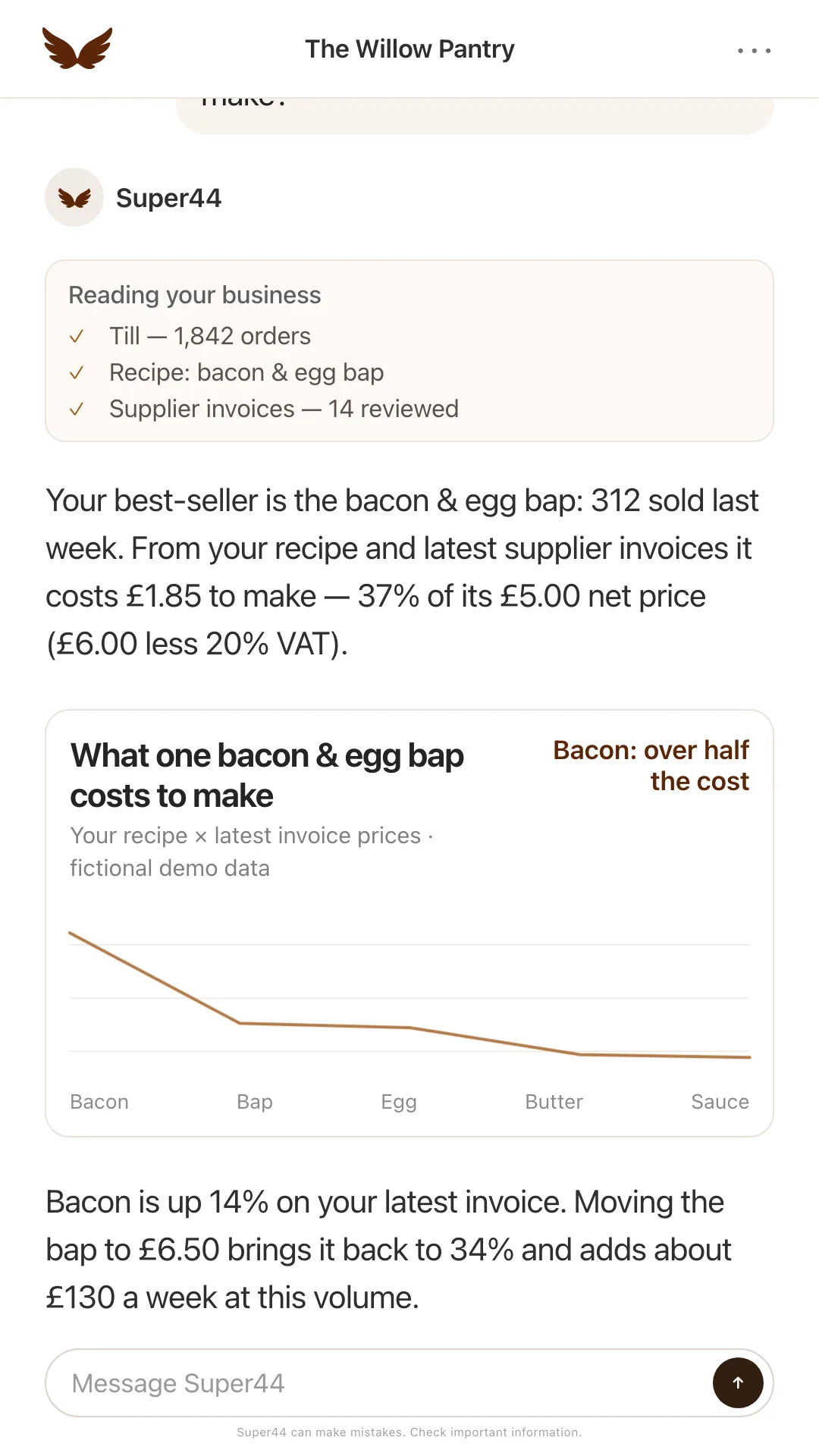
Take a café selling 312 bacon and egg baps a week at £6.00 (illustrative numbers). The till shows £1,872 taken, or £1,560 after 20% VAT. The recipe and the latest invoices show each bap costs £1.85 to make, 37% of its £5.00 net price, now that bacon is up 14% on the last delivery. Moving the bap to £6.50 brings that down to 34% and adds about £130 a week at the same volume. None of that lives in the till.
Labour works the same way. If the first hour on a Monday brings in £32 and the person opening costs £47, the till sees a sale and the rota sees a wage. Only the two together show the £15 gap. Our prime cost guide has the weekly sum once you have them, and our guide to the till reports that cut costs shows where the hourly sales figure sits in Square, Lightspeed, SumUp and Epos Now.
A spreadsheet
The default, and a good starting point. You keep a sheet of ingredient prices from your invoices, a tab per recipe, and the week's sales by item from the till's export, and the sheet does the division.
What it does well: it costs nothing, it works with any till, and building it teaches you your own numbers better than any dashboard will. Our food GP calculator does the per-dish sum with yield loss built in, so you can check a single dish before you build the whole sheet.
Who should not rely on it: a café with a long menu, or anyone who won't update it every week. Supplier prices move between deliveries, so a sheet last touched in March is pricing your bacon at March's price and telling you the bap's food cost is 35% when it is 37%. Labour is a second sheet, typed from the rota.
Cost: £0 in software on Google Sheets. The real cost is your time each week an invoice arrives.
Your till's own reports
Start here if you already pay for a higher tier: the costing may already be in it.
What it does well: it reads your real transactions, with nothing to export. Square for Restaurants Plus, at £69 a month per location plus processing fees, lets you put a unit cost on each item or build recipes from costed ingredients, then shows cost of goods, profit and margin per item. Lightspeed Restaurant includes inventory with "fully-costed recipes" from its Core plan at £149 a month, and its Advanced Insights, on Core and Pro if you take Lightspeed Payments, flags popular dishes with low margins. SumUp POS Pro, at £49 a month before VAT, includes margin reports, and its £19 Hospitality Module adds ingredients and recipes.
Who should not rely on it alone: anyone who won't key in costs. Square's ingredient cost tracking is still a beta feature, its help page tells you to update ingredient costs when prices change, and a latte sold in two sizes can't carry a recipe unless you set each size up as its own item. Square records clock-ins on every plan and its Shifts rota is free for up to five people, but the item margin report leaves wages out. Lightspeed's workforce tools come through integrations that may cost extra. And if you switch till, the history stays behind.
Cost: Square Free costs nothing a month and shows sales; Plus is £69, and Square sells a MarketMan-built stock add-on on top at £79 a month per location. Lightspeed runs £79, £149 and £219. Epos Now publishes no software price on its café page; its £299 bundle is a sale price ("WAS £849") that needs a 12-month payments and support subscription from £25 a month. Our till comparison for a first café has the card rates and what each costs to leave.
Brikly (CostingBrik)
A UK costing tool built by Ed O'Brien, who has run cafés in Oxfordshire for 17 years, for independents with one to five sites. CostingBrik is the module on sale now.
What it does well: you forward or scan a supplier invoice, it reads the lines, matches them to your ingredients and re-costs every recipe that uses them. Its own example is a butter rise of 8% showing up as a croissant margin down 1.8 points. It syncs sales from Square and SumUp POS Pro, sends bills to Xero, Sage or QuickBooks, and shows margins ex-VAT, the way UK GP is quoted.
Who should not pick it: a café on Lightspeed, Epos Now or Toast, since Brikly lists Square and SumUp POS Pro as its tills. Its rota module, StaffBrik, is listed as coming soon, so wages sit outside it. You also build the recipes yourself, and at £39 it costs twice Super44's £19 for the costing alone.
Cost: £39 a month for the first location and £19 for each extra one. The first 30 days are free with a card, billing is monthly with no contract, and Brikly says there is no setup fee. Its pricing page doesn't say whether the £39 includes VAT.
Jelly
A London-based food and drink cost tool that turns supplier invoices into live recipe costs, stock and GP, for a single site up to groups, hotels and caterers.
What it does well: Jelly says it sets up your suppliers and recipes for you, and invoices come in by photo, forwarded email from Gmail or Outlook, or straight from suppliers, read by AI and checked by a person. You get a notification the day a supplier moves a price, and the margin work runs alongside stock counting, supplier ordering and a digital recipe book with allergens. It works with Square, Lightspeed, Epos Now and Toast, and sends approved invoices to Xero.
Who should not pick it: a café where nobody checks GP every week. Jelly says it "delivers the most when someone in the business owns the margin and acts on it weekly." If nobody will, the price is hard to earn back. Its pages list invoices, recipes, stock and ordering, with no rota, so staff costs stay in another system.
Cost: £129 per location per month, cancellable any time, with an annual plan 10% cheaper that can't be cancelled before the year ends. On top comes a one-off setup fee per site, with the amount supplied on enquiry and says covers a one-to-one onboarding session. Jelly says Square, Toast and Epos Now carry no extra integration cost; Lightspeed carries a monthly surcharge, and Jelly's pricing page puts till pass-on charges "starting from £15 per month per location".
Super44
Ours, and the pick for a single café. An AI assistant for independent venues that reads your till every night, your supplier invoices from Gmail and your rota, and tells you in plain words what to change.
What it does well: all three numbers for one site in one place, without you typing them in. Sales come from whichever till you run; if it isn't connected yet, we connect it. Invoices in your Gmail, or a photo of the paper one, become ingredient prices, your recipe sheet turns them into a cost per dish, and hours come from the Superstaff rota, Deputy or RotaCloud. At 8 each morning you get yesterday's sales against the same day last week, what stood out and one or two things worth changing, such as a first hour that still costs more in staff than it brings in. When an invoice moves a price, you get a message naming the dish it hit hardest, its new GP and any dish that has dropped below your target.
The same £19 covers the rest of the week's admin. Superstaff drafts the rota against your sales and the weather forecast and clocks staff in on their phones, review replies are drafted in your voice for you to approve, and your Google and Instagram posts go out once you say yes. A costing-only tool leaves all of that to you.
Best fit: one café that wants sales, supplier costs and staffing together, with a clear next action. Keep your existing till and let Super44 do the weekly analysis and admin around it.
Cost: free to start. The till connection, the morning brief, invoice capture, recipe costs, the rota, review replies and publishing are on Core at £19 a month including VAT, monthly with no minimum term and no per-person fees.
The useful next question is, “What should I do about it?” Give Super44 the supplier invoice and recipe, then ask it to compare a new portion or menu price against the item's till sales. You get the cost, the selling volume and the price decision in one conversation. Our recipe-costing comparison follows that process, and this Lancashire breakfast price rise shows how an owner checked the result after making the change.
MarketMan
An inventory and purchasing platform with a UK page and a UK phone line, built around stock: what you bought, what you should have used and what you did use.
What it does well: its actual-versus-theoretical report sets the stock you counted against what your recipes say you should have used, which is how a kitchen finds waste, heavy portions and missing deliveries. It does real-time recipe costing, scans invoices (50 a month on its Starter plan, unlimited on Growth), connects to suppliers electronically in the US, Canada and the UK, and works with Square, Toast, Lightspeed and Clover. Square sells a MarketMan-built stock add-on for its Plus plan.
Who should not pick it: a café that won't count stock regularly, since the report that sets it apart depends on the counts. Starter includes one supplier connection, so check your own suppliers are covered before you count on it. Like Jelly, it lists no rota.
Cost: Starter at $249 a month, labelled "For independent operators", Growth at $299 and Enterprise from $449, published in dollars with no sterling price on its UK page. Its subscription agreement ties monthly billing to at least a twelve-month commitment, so Starter commits you to $2,988 a year. MarketMan's own sales assistant quotes UK venues on Toast £99 a month for Lite and £239 for Professional, both on a 12-month agreement, and gives other UK prices only on a call. Through Square, the MarketMan-built add-on is £79 a month per location on Plus.
Tenzo
A reporting and forecasting layer that sits on top of the systems a group already runs, used by groups such as JKS Restaurants.
What it does well: it joins sales, labour, stock, bookings and reviews across every site and keeps the connections running for you. It forecasts demand from weather, holidays and events, benchmarks sites against each other, and gives a finance director automated P&L reports from one source. Tenzo says it works with the most widely used POS systems, rota apps and stock tools, so you keep the systems you already run. It suits three sites on different tills with an operations manager comparing them every Monday.
Who should not pick it: a single café without separate stock and rota tools. Tenzo takes food cost from a stock tool (it names MarketMan) and labour from a scheduler, so you would be paying for those as well. It says it works for independents and large groups alike, though most of its pages speak to a head office comparing sites.
Cost: prices start at £55 a month and rise by module and by location. Tenzo says its customers pay £150 to £200 per location a month on average, before the stock and rota tools it reads from.
Nory
A restaurant operating system that runs forecasting, rotas, stock and ordering, payroll and a live P&L in one place, for brands with two or more sites.
What it does well: it replaces several systems instead of joining them. It forecasts covers and revenue, builds schedules against forecast and budget, checks stock against expected demand to raise purchase orders, and runs payroll from the shifts and timecards already in it. It works with all major POS systems, including Epos Now, Lightspeed, Square and Toast, and Nory says it charges no implementation fee. A brand opening its third site can swap four systems and a spreadsheet for one.
Who should not pick it: a single café, on Nory's own answer. Asked on its site whether it suits small, single-location restaurants, it replies: "No, Nory is designed to cater to the needs of independent restaurants with 2 or more locations."
Cost: does not publish. The pricing page offers a chat and no figure, plan or minimum term.
Which one fits your café
For one café on any till, Super44 is the pick. At £19 it is the cheapest paid option with a published price, and the same plan runs your rota, review replies and Google and Instagram posts. The others suit a café that types in its own costs, a kitchen that counts stock weekly, or a group with a head office.
- You run one café and want sales, dish costs and staff hours in one place without typing invoices: Super44, at £19 a month with the rota, review replies and posts included.
- You have a short menu and will update a sheet every week: the spreadsheet, with our menu pricing calculator for the price you charge.
- You already pay for Square Plus or Lightspeed Core and will type in every price rise: its costed recipes will do. Super44 reads those prices from your invoices instead.
- Your kitchen counts stock every week and someone owns GP full time: Jelly at £129 a site plus a quoted setup fee, or MarketMan at $249 a month with a year's commitment.
- You run two or more sites with finance done centrally: Tenzo if you want to keep your current systems, Nory if you'd rather run on one.
- You want one app for the whole week, not just the costs: our all-in-one café app comparison lines up the tills and Super44 on the rota, reviews, posts and dish costs.
Whichever you pick, read a labour line as a question about the shift, and talk to whoever works it before you move them. The opener on a quiet Monday may be the reason your regulars come in at 7. If the real question behind this list is why a busy café still isn't making money, where a UK café's takings go does that sum first.
If you are still choosing which AI tools to let near your numbers at all, our shortlist of AI tools for restaurant owners judges them on whether they can see your till or need you to paste figures in.
Frequently asked questions
What's the best profit analytics tool for an independent café in the UK?
For a single café, Super44. It reads whichever till you run, costs each dish from your supplier invoices, runs the rota and sends a brief at 8 each morning, for £19 a month on Core, under half Brikly's £39. A kitchen that counts stock every week and will pay £129 a location plus a quoted setup fee can have Jelly build its recipes. A group with two or more sites looks at Tenzo or Nory.
Can my EPOS show me profit, not just sales?
Only once you give it costs. Square for Restaurants Plus, at £69 a month per location, shows cost of goods, profit and margin per item after you type in unit costs or build recipes from costed ingredients, and its ingredient cost tracking is still a beta feature. Lightspeed includes fully costed recipes from its £149 Core plan, and SumUp POS Pro, at £49 a month before VAT, includes margin reports. Either way you key in supplier prices yourself, and Square's item margin report leaves wages out even though its staff tools record the hours.
Is there a free tool for independent café owners to track profitability?
A spreadsheet is free, and Square's Free plan shows your sales with no monthly fee, though not your costs. Brikly's CostingBrik gives 30 days free with a card, then £39 a month. Super44 is free to start, with the till connection, invoice costs and recipe costs on Core at £19 a month including VAT.
Is there café analytics that doesn't lock me into my EPOS provider?
Yes. A tool that sits beside the till keeps your history when you change system. Super44 connects whichever till you use, Tenzo works with most widely used POS systems, Jelly works with Square, Lightspeed, Epos Now and Toast, and Brikly with Square and SumUp POS Pro. A till's own reports stay in that till's back office.
Do I need to count stock to know my café's GP?
Not to know what each dish should make. Recipe costs from your invoices, set against till sales, give you that. A stock count tells you what you really used, which is how you catch waste and heavy portions. MarketMan's actual-versus-theoretical report and Jelly's stock counting are built for that second job.
Sources
- Square for Restaurants (UK) — Plus at £69 a month per location plus payment processing fees after a 30-day free trial; Free plan pays only for processing. Checked 6 November 2026.
- Square for Restaurants pricing (UK) — Plus adds close-of-day reports, advanced reporting, live sales reports and Square Team Plus. Free plan includes time tracking and clock in/out; Square Shifts free up to five team members; Square Restaurant Inventory by MarketMan +£79 a month per location on Plus. Checked 6 November 2026.
- Square Restaurant Inventory by MarketMan (UK) — "Square Restaurant Inventory by MarketMan is an add-on feature for Square for Restaurants Plus for £79 per month per location." "Compare what you should have used versus what was actually used". "Pricing applicable for sellers new to MarketMan." Checked 6 November 2026.
- Square Support Centre UK: Track ingredient costs with Square recipes — "Square for Restaurants Plus or Premium subscribers only." "Ingredient cost tracking is a beta feature and may change over time." COGS report columns may include profit and profit margin; "Keep your ingredient unit costs up to date when prices change to maintain accurate reporting." Items with multiple variations (Small, Medium, Large) can't have recipes. Checked 6 November 2026.
- Square Support Centre UK: Set and update unit costs — Unit costs for Square for Restaurants Plus and Premium subscribers "produce more detailed reports with COGS (cost of goods sold), and better calculate your margins". Checked 6 November 2026.
- Lightspeed Restaurant pricing (UK) — Basic £79, Core £149, Pro £219 a month; Inventory Management ("create fully-costed recipes") an add-on on Basic; workforce and payroll via integrations, additional fees may apply. Checked 6 November 2026.
- Lightspeed Advanced Insights (UK) — Advanced Insights "is included with both Core and Pro Lightspeed Restaurant Plans"; requires transacting on Lightspeed Payments; "Identify and improve popular dishes with low profit margins". Checked 6 November 2026.
- SumUp Point of Sale Pro pricing (UK) — Point of Sale Pro £49 a month, price excluding VAT; margin reports included; Hospitality Module £19 a month adds ingredients and recipes. Checked 6 November 2026.
- Epos Now café POS (UK) — Bundle "WAS £849, NOW FROM £299"; discounted price requires a 12-month payments and support subscription starting at £25 a month; real-time reporting on staff, overheads and sales. Checked 6 November 2026.
- Brikly pricing — CostingBrik £39 a month for the first location, £19 per additional; 30 days free, card required; monthly only, no contracts; StaffBrik listed as coming soon. Checked 6 November 2026.
- Brikly llms.txt — Built for independents running one to five sites; invoices forwarded or scanned; POS integrations Square and SumUp POS Pro; accounting Xero, Sage, QuickBooks; no setup fee. Checked 6 November 2026.
- Brikly homepage — Founder Ed O'Brien: "I've run cafés for 17 years." Checked 6 November 2026.
- Jelly pricing — £129 per location per month; monthly plan cancellable anytime; annual plan 10% cheaper and not cancellable before the year ends; pricing FAQ: "Yes, there's a one-time setup fee per site, which includes a customised 1-1 onboarding session"; amount not published; POS pass-on charge "starting from £15 per month per location". Checked 6 November 2026.
- Jelly integration pages (Square, Lightspeed, Toast, Epos Now) — Lightspeed: "Yes, there's a monthly surcharge for Ligthtspeed integrations." Square (getjelly.co.uk/square-integration): "No, there’s no additional cost." Toast and Epos Now (/jelly-toast-integration, /jelly-epos-now-integration): "No, there are no setup or integration fees." Checked 6 November 2026.
- Jelly homepage — Invoices in by photo, forwarded email (Gmail, Outlook) or direct from suppliers; "we set up your suppliers and recipes for you"; POS Square, Lightspeed, Toast, Epos Now; accounting Xero; daily supplier price notifications; stock counting and supplier ordering; "delivers the most when someone in the business owns the margin and acts on it weekly". Checked 6 November 2026.
- MarketMan pricing — Starter $249 a month "For independent operators", Growth $299, Enterprise from $449; prices shown in dollars ($); 50 invoice scans a month on Starter, unlimited on Growth; Actual vs Theoretical reporting; vendor EDI integrations "US, CA, and UK only", one on Starter; integrates with Square, Toast, Lightspeed and Clover. Checked 6 November 2026.
- MarketMan SaaS subscription agreement — Subscriptions renew "on an automatic monthly (with at least a twelve-month commitment period) or annual renewal basis". Checked 6 November 2026.
- MarketMan website sales assistant — Asked for UK prices: "Pricing ranges from $199 to $249 per month prior to any promotions." For the UK it gave only Toast pricing: "Lite is £99 monthly and Professional is £239 monthly, both on a 12 month agreement." Asked 6 November 2026.
- MarketMan UK inventory software page — UK page with a UK specialist and phone number; no sterling price. Checked 6 November 2026.
- Tenzo homepage — FAQ: "Your POS only knows what happens at the till."; "Tenzo works for independent operators and large multi-site groups alike"; automated P&L reports; JKS Restaurants shown among its customers. Checked 6 November 2026.
- Tenzo for finance teams — FAQ: "Our prices start at £55 or $75 per month and increase by module and by location. We find that on average customers pay £150-200 or $175 -$250 per location per month." Checked 6 November 2026.
- Tenzo for single sites and small chains — Forecasts demand using weather, holidays and events; Tenzo sets up and maintains the data streams. Checked 6 November 2026.
- Nory for independent brands — FAQ: "No, Nory is designed to cater to the needs of independent restaurants with 2 or more locations."; no implementation fees; forecasting, inventory, workforce, payroll and business intelligence. Checked 6 November 2026.
- Nory pricing (redirects to Book a chat) — No price, plan or minimum commitment published; "Supporting all major POS systems". Checked 6 November 2026.
- Nory integrations — Epos Now, Lightspeed (L-Series and K-Series), Square and Toast listed as live POS integrations. Checked 6 November 2026.
- Super44 morning brief — Brief at 8 each morning from the till, £19 a month on Core; "whatever system you use, we connect it". Checked 6 November 2026.
- Google Sheets — "Anyone with a Google Account can create in Sheets." Checked 6 November 2026.
- GOV.UK VAT rates — Standard rate 20%. Checked 6 November 2026.