ChatGPT Prompts for Bar Owners: Cocktail Menu Ideas, Drinks Costing and Quiet-Night Events
Six copy-ready ChatGPT prompts for a UK cocktail bar or bar-pub: a seasonal cocktail menu from the bottles you already stock, a cocktail costed to a target GP, an invoice check, an upselling script, and a quiet-night event with its posts. Each comes with what to paste in, what to check and the step you will repeat by hand.

Alex Riesenkampff
22 November 2026 · 16 min read · Markdown
The ChatGPT prompts that earn their place behind a UK bar give the model your real specs, the prices you pay and the format you want back. Then they make it show its working in a table. Six of them cover most of a bar owner's week: they write a seasonal cocktail menu from the bottles you already stock, cost a serve against a target GP, check an invoice, script the upsell, plan a quiet-night event and announce it. Paste in your own numbers, check the table that comes back, and know which step lands on you again next week.
| Job | What to paste in | What comes round again |
|---|---|---|
| Seasonal cocktail menu | Your back-bar list, prep, price range | Which cocktails sold, from the till |
| Cost a cocktail | Spec in ml, prices you pay without VAT, menu price | New prices from every invoice |
| Invoice check | The new invoice, last prices, your specs | The next invoice |
| Upselling script | What to suggest, menu, house tone | Who on the team sells add-ons, from the till |
| Quiet-night event | Normal takings, extra costs, spend per guest | That night's takings, before and after |
| Event posts | Date, time, facts, tone | Posting to Instagram and Google yourself |
Write a seasonal cocktail menu from the bottles you already stock
Ask ChatGPT for next season's menu from the bottles already on your back bar, with a cap on new ones, and you get drinks you can pour on Monday instead of a shopping list. CGA by NIQ's February 2025 Mixed Drinks Report found menus were the top influence on cocktail choice for 64% of consumers, and that 46% preferred classic cocktails, down 6 points in a year, while 17% preferred modern ones.
That points to a menu built on classics with two or three new drinks in it.
There’s no escaping the fact that the trading environment for spirits is difficult at the moment, but cocktails provide an exciting chance to make up the lost ground in 2025.
Paste in every bottle with its size, the fresh prep you already buy and your price range. Add last season's best sellers if you know them, because the model will otherwise guess what your guests like.
Seasonal cocktail menu from the back bar
You are the bar manager of [bar name], a [cocktail bar / bar-pub] in [town], writing the [season] cocktail menu.
Bottles already on the back bar: [paste each bottle with brand and size].
Fresh and prep we already buy: [e.g. lemons, limes, oranges, mint, sugar syrup, aquafaba, espresso].
Our guests and price range: [e.g. "after-work crowd, cocktails £9.50 to £12"].
Last season's best sellers: [list them, or write "unknown"].

Write a menu of [8] cocktails.
1. At least [6] must use only the bottles and prep listed above.
2. Add no more than [2] new bottles in total, and say which drinks each new bottle serves.
3. For each drink give: name, a menu line under 15 words, the spec in ml, glass, garnish and the bottles it uses.
4. Include at least one stirred drink, one sour, one long drink and one low or no-alcohol drink.
5. Any drink with fewer than three liquids must use our [25ml / 35ml] measure, or a multiple of it, for gin, rum, vodka and whisky.
6. Finish with a table of every bottle and how many menu drinks use it, and flag any bottle used by only one drink.
Do not invent bottles I have not listed, and do not set prices yet.
A good answer reads like your bar, uses each opened bottle more than once and makes the new bottles earn their place. Taste every spec before it goes on the menu, because a model can balance a sour on paper and still miss on the night. For the alcohol-free line, the Dry January pricing guide shows why a mocktail is not a cheap pour.
Cost a cocktail per serve and price it from a target GP
To cost a cocktail, give ChatGPT the spec in millilitres, what you pay for each bottle without VAT and the menu price, then make it work in a table with every formula shown. GP is worked on the price without VAT, so a £11.50 cocktail brings in £9.58 once 20% VAT comes off, and a serve costing £2.26 runs at 76.4% GP.
Here is the house gin martini at The Lantern, a demo cocktail bar in Leeds, after its gin went from £19.50 to £23.00 a bottle.
| Ingredient | Pack | Price without VAT | Used | Cost per serve |
|---|---|---|---|---|
| London dry gin | 70cl | £23.00 | 60ml | £1.97 |
| Dry vermouth | 75cl | £11.00 | 15ml | £0.22 |
| Orange bitters, olive, ice | £0.07 | |||
| Total | £2.26 |
At £11.50 on the menu, the price without VAT is £9.58 (£11.50 ÷ 1.2), the gross profit is £7.32 and the GP is 76.4%. Before the price rise the gin cost £1.67 a serve, the martini £1.96, and the GP was 79.5%. To get back to a 78% target the menu price needs to be just over £12.30, so The Lantern rounds up to £12.50, which gives 78.3%.
The 60ml pour is legal because a martini of gin, vermouth and bitters is a mixture of three liquids. The Weights and Measures (Intoxicating Liquor) Order 1988 exempts those from the 25ml or 35ml rule. A gin and tonic is two liquids, so its gin goes in your house measure or a multiple of it. For spirit-and-mixer serves, the drinks GP calculator runs the same sum at 25ml and 35ml.
Cost a cocktail and set its price
You are a bar manager costing cocktails for a UK bar. Our menu prices include 20% VAT, and GP is worked on the price without VAT.
Cocktail: [name]
Spec: [each ingredient with its amount, e.g. "60ml gin, 15ml dry vermouth, 2 dashes orange bitters, olive"]
What we pay, without VAT: [each ingredient's pack size and price, e.g. "gin 70cl £23.00", plus a cost per serve for garnish and ice]
Current menu price: [£]
Target GP: [e.g. 78%]

Work in a table with one row per ingredient: pack size, pack price, amount used, cost per serve, and the formula for that row. Then show, each with its formula:
1. total cost per serve;
2. price without VAT = menu price / 1.2;
3. GP % = (price without VAT - cost per serve) / price without VAT;
4. the lowest menu price that reaches the target GP = cost per serve / (1 - target GP) x 1.2, then rounded up to the next 50p;
5. the GP at that rounded price.
Round to the penny only at the end. If any price or amount is missing, list what is missing and stop instead of guessing.
Look for a formula on every row and totals that land where the table above does. Check the total against your own spreadsheet once; after that, the prompt is reusable for every drink on the list. If the answer says raise the price, guests may mind less than you fear. A Mexican restaurant and bar group in London put two signature cocktails up from £11 to £12. Super44 tracked both still selling 10 to 30 a day on busy nights.
Check your drinks list against a new spirits invoice
When a spirits invoice arrives higher than the last one, paste it in with your old prices and your specs. Ask for every drink it touches, re-costed, with the ones below target flagged. UK alcohol duty rises 4.55% with RPI on 1 February 2027, to £35.54 per litre of alcohol for spirits, which is about 43p more duty on every 70cl bottle at 40%.
That 43p is spread across the 28 serves of 25ml in a bottle, so a single serve barely moves. A martini built on a 60ml pour moves more, and a gin price rise on top of duty moves everything. Whenever your supplier passes it on, the check is the same.
Check the drinks list against a new invoice
You are checking a UK bar's drinks margins after a new supplier invoice. Invoice prices are without VAT; our menu prices include 20% VAT.
New invoice: [paste every line: product, pack, quantity, price]
What we paid last time: [the same products, old price per bottle]
Our drinks: [each drink's name, spec in ml and menu price]
Our target GP: [e.g. 78% on cocktails, 75% on spirit and mixer]

1. Check that the invoice total matches the sum of its lines, and tell me if it doesn't.
2. Make a table of every product whose price per bottle changed: old price, new price, change in £ and %.
3. For every drink that uses one of those products, recalculate the cost per serve and the GP before and after, with the formula. Group the drinks by product.
4. Flag every drink now below its target GP and give the lowest menu price, rounded up to the next 50p, that brings it back.
5. List any drink whose spec or price I haven't given you, instead of estimating it.
The answer to look for is a short list: the two or three drinks that need a new price, and by how much. A ChatGPT project saves you retyping the specs, because "Projects keep related chats, files, and instructions together", in OpenAI's words. The prices are the catch. The chat knows them only as of the last invoice you pasted, so every new invoice means the same paste, the same table and the same check.
How Super44 does the invoice check for you
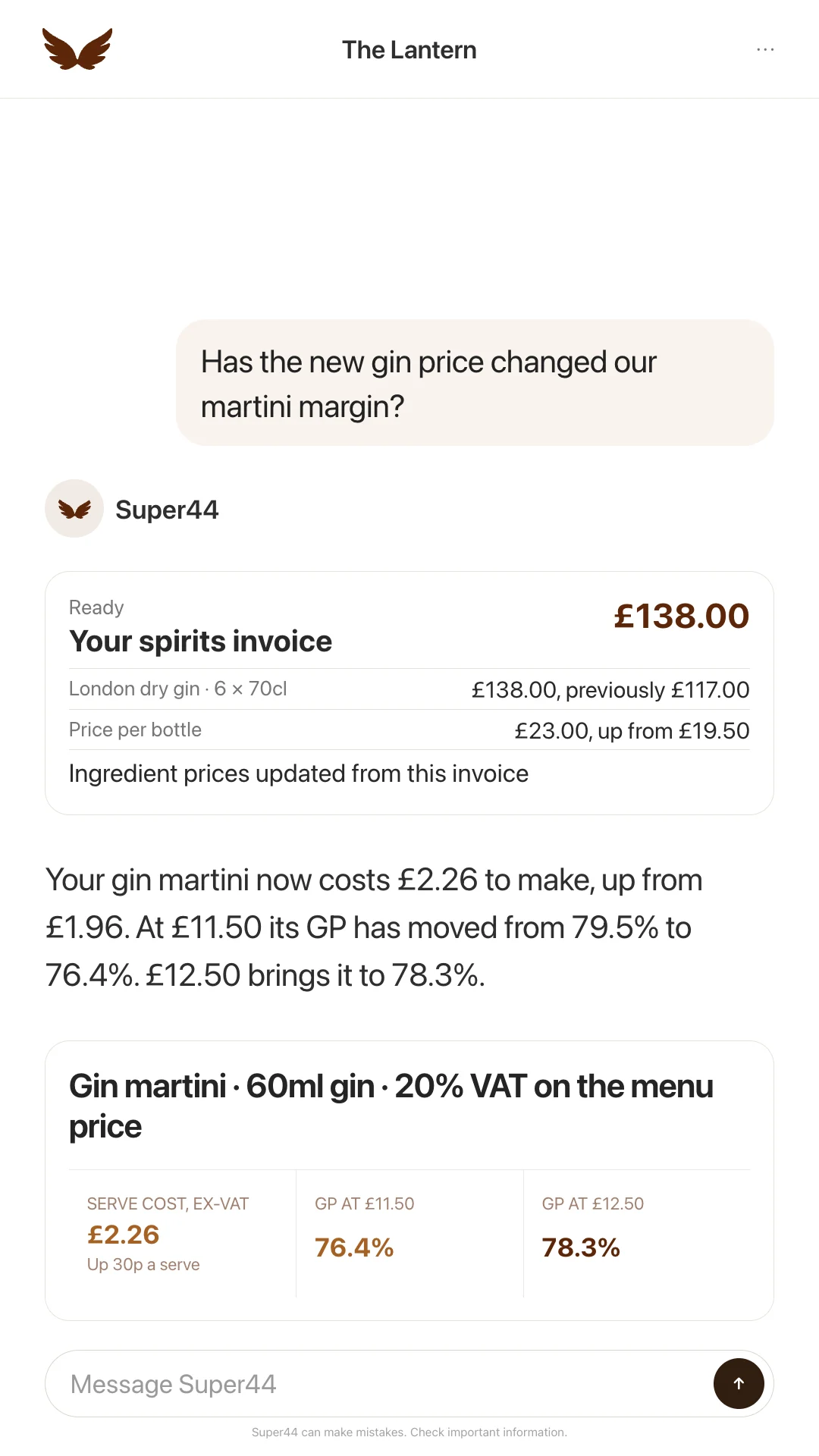
In Super44 the invoice check starts from the invoice itself: recipe costing reads each new supplier invoice, re-costs every saved cocktail that uses what went up, and flags the drinks that slipped below target. Ask, and it suggests the price that brings each one back. At The Lantern, the gin case at £138.00 instead of £117.00 takes the martini from £1.96 to £2.26 a serve, and Super44 suggests £12.50 to bring it back above the 78% target, at 78.3% GP.
Picture the week. The supplier's invoice lands in your Gmail on Tuesday morning, or you photograph the paper copy at the bar, or forward it in the chat. Super44 reads it against your saved specs. You ask "Has the new gin price changed our martini margin?" and get three lines back: the new cost, the GP at today's price and the price that gets you back to target. The same goes for every other drink the gin is in. Changing the menu stays your decision.
Train the team to upsell without pushing
An upselling script works when it gives each bartender one natural line for one moment, and something easy to say when the guest says no. At a bar and café in Berlin's Prenzlauer Berg, Super44 found about €25,000 a year of extra add-on revenue, with no extra guests, if the whole team matched the top server's 36.5% add-on rate.
That gap sat inside one team selling one menu. Give ChatGPT what you want guests to try, your prices and how your bar talks, and ask for practice as well as lines.
Upselling script for the bar team
You are a bar trainer writing a short upselling script for the team at [bar name], a [type of bar] in [town].
What we want guests to try: [e.g. "a premium gin for £2 more", "a second round of the same cocktail", "olives or nuts with the first round"].
The relevant menu and prices: [paste them].
When it should happen: [e.g. first order at the bar, when a glass is two-thirds empty, table service on Fridays].
House tone: [e.g. "friendly, never pushy, lots of regulars"].

Write:
1. one opening line for each moment, under 15 words, in the words a bartender would say out loud;
2. what to say if the guest says no, so nobody hears a second push;
3. two lines that never work in a bar like ours, and why;
4. a five-minute pre-shift practice with three role-play situations, one of them a guest who has had enough to drink, where the right answer is water and no upsell.
Read the lines aloud with the team. If a line sounds like a script, guests will hear it as one, so let each bartender reword it. The prompt can't tell you who on the team already does this well. That sits in your till's sales by server. Super44 found the Berlin gap by comparing each server's add-on rate.
Plan a quiet-night event that pays for itself
Before you book a quizmaster or a band, ask ChatGPT how many extra guests each idea needs to cover its own costs, worked from your average spend and your drinks GP. A quiz with an £80 quizmaster and £20 of prizes breaks even at seven extra guests spending £24 each at a 72% GP: £24 is £20 without VAT, which leaves £14.40 of gross profit a head.
Seven extra guests on a Wednesday is a realistic test. Twenty is a hope. Super44 found a bar and late-night club with a daytime café in North Yorkshire taking £33 to £118 on a plain Wednesday late. It needed about £200 to break even, while a payday Wednesday took £1,566. Sometimes the answer is to close: a cocktail bar in Germany now shuts earlier Tuesday to Thursday, after a four-week trial with a way back. Our costed playbook for empty weeknights covers both routes.
If the night has music, live or recorded, the licence belongs in the costs; what a music licence costs a bar shows how each tariff is worked out. In England and Wales, the mandatory licensing conditions ban irresponsible promotions. They include unlimited drinks for a fixed or discounted fee where that risks the licensing objectives, and games that push people to drink as much as possible, so the prompt rules them out.
Quiet-night event with a break-even
You are helping me plan one event to fill a quiet night at [bar name], a [cocktail bar / bar-pub] that holds [number] guests.
The night: [e.g. Wednesday]. What it takes now: [e.g. "£350 on a normal Wednesday, from the till"].
Average spend per guest: [£, including VAT]. Our average drinks GP: [e.g. 72%].
Ideas I'm weighing: [e.g. quiz, live acoustic set, gin tasting].
Extra costs for each idea: [e.g. quizmaster £80 and prizes £20; musician £150; music licence; tasting samples; extra staff hours].
Ticket price, if any: [£ per ticket, including VAT].

For each idea:
1. list the extra costs, and name any cost I haven't given you;
2. calculate the extra guests needed to cover them, with the formula: extra costs / (average spend / 1.2 x GP), counting ticket income without VAT if there is any;
3. say what turnout would make it worth repeating, and after how many weeks I can judge it.
Rank the ideas by the extra guests each one needs. Do not suggest drinks offers that encourage people to drink more or faster, such as unlimited drinks for a fixed price or drinking games.
A good answer ranks the ideas and names the cost you forgot, which is often staff hours or the licence. Run any event for four weeks before you judge it, because the first night rarely shows the pattern.
Announce the event on Instagram and Google
Ask for both posts in one prompt, with the date, time and facts in it, and tell ChatGPT to keep any drinks deal out of the Google version. Google's Business Profile policy lists alcohol as restricted and rules out "deals, coupons, pricing information or other promotions" for it, so a Google post can sell your quiz night but not a drinks offer.
For The Lantern's Wednesday quiz, the facts line is four items: 8pm start, teams of up to six, free entry, book a table or walk in. That is enough for both posts, and it gives the Google version nothing it has to leave out.
Event posts for Instagram and Google
Write two posts announcing [event] at [bar name] on [day, date] from [start time] to [end time].
Facts: [what happens, entry price or free, book or walk in, team size for a quiz, anything guests need to know].
Our tone: [e.g. "dry, warm, no exclamation marks, no emoji"].
Photos we have: [describe two or three of your own photos].

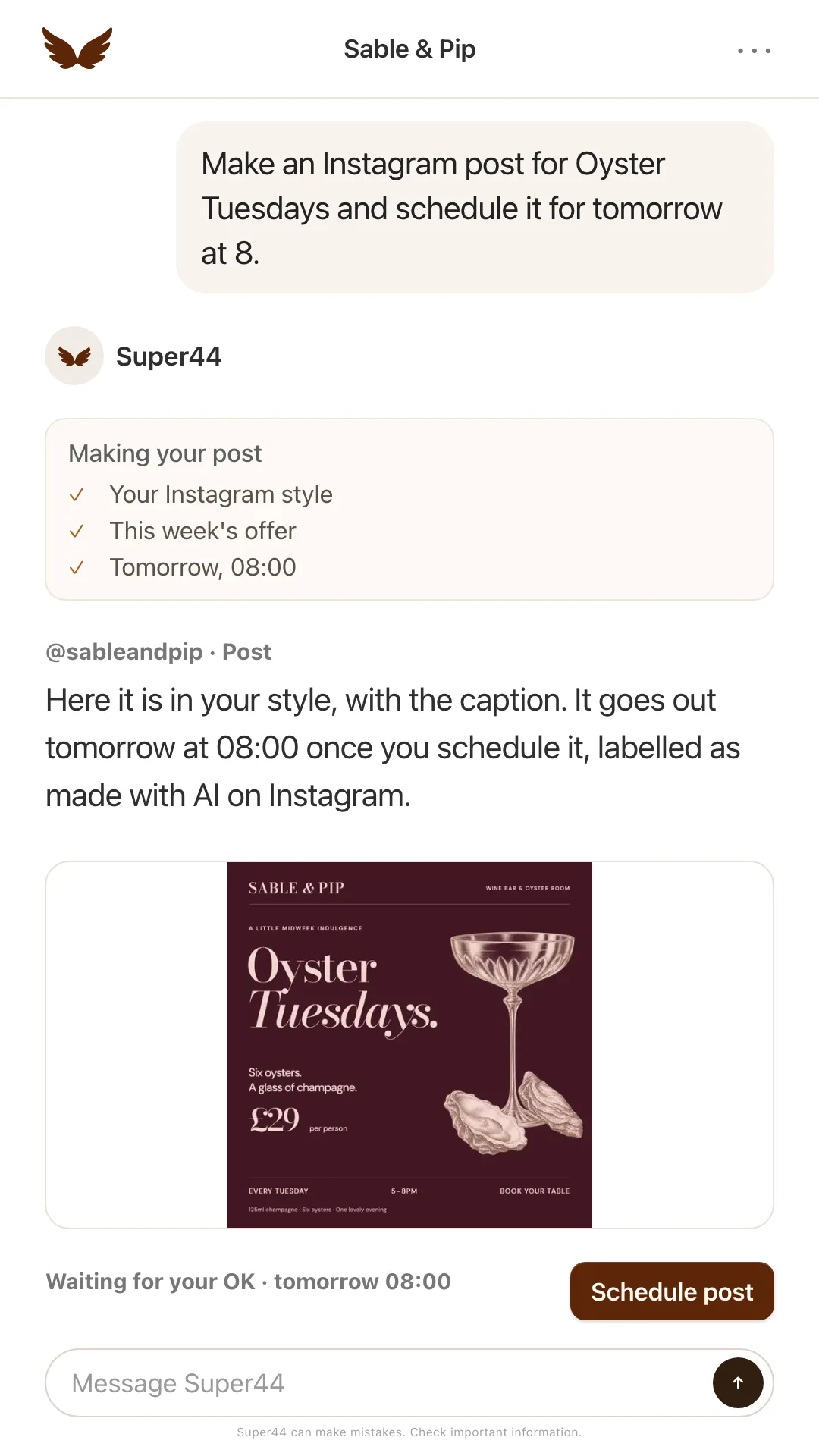
1. Instagram: a first line that works on its own, then three short lines, a call to action and up to 5 hashtags. Say which of our photos to use.
2. Google Business Profile event post: a title, the date and time, and under 80 words of text.
Keep drinks deals and drinks prices out of the Google post, and keep anything that encourages drinking more or faster out of both posts. Do not invent any fact I have not given you.
Check the date, the day and the start time against your calendar before anything goes out, because a wrong day costs you the night.
Which prompt to start with
Start with the costing prompt on your five best-selling cocktails, because a price that has drifted below target costs you on every serve until you notice it. At 40 martinis a week, The Lantern's 30p rise in serve cost is £12 a week, or £624 a year, from one drink on one invoice.
- This week: cost your top five cocktails and fix any price below target.
- Every spirits invoice: run the invoice check, and put a reminder in for the first invoice after 1 February.
- Each season: write the menu from the back bar, then refresh the upselling script to match it.
- When a night is dead: plan one event with its break-even and judge it on four weeks of takings.
The general ChatGPT prompts for restaurants cover review replies, rotas and supplier emails. Once you are pasting invoices and till exports into a chat every week, the upload has become the job, and Super44 or ChatGPT compares the two job by job.
Frequently asked questions
What are the best ChatGPT prompts for a bar owner?
The ones that give ChatGPT your real specs, prices and facts and ask for a table with the working shown. Six cover most of a bar's week: a seasonal cocktail menu from the bottles you already stock, the cost of a serve against a target GP, a check of your drinks list against a new spirits invoice, an upselling script, a quiet-night event with its break-even, and the posts that announce it.
Can ChatGPT cost my cocktails?
Yes, if you give it the spec in millilitres, the pack size and the price you pay without VAT for every ingredient, and the menu price. Ask it to work in a table, show each formula and list any missing price instead of guessing. A 60ml gin martini with £23.00 gin, £11.00 vermouth and 7p of bitters, olive and ice costs £2.26 a serve.
How do I work out the GP on a cocktail in the UK?
Take 20% VAT off the menu price by dividing it by 1.2, subtract the cost of the serve, and divide what is left by the price without VAT. A £11.50 cocktail is £9.58 without VAT; with a £2.26 serve cost the GP is £7.32, or 76.4%.
Can I advertise a drinks offer in a Google post?
No. Google's Business Profile policy lists alcohol as restricted content and does not allow deals, coupons, pricing information or other promotions for it. Promote the event itself on Google, such as the quiz, the music or the tasting, and keep any responsible drinks offer for Instagram or your own board.
Can ChatGPT post my bar's event to Instagram and Google?
It drafts the captions and can make a poster, but it does not publish them for you. You download the image, post it to Instagram and paste the text into your Google Business Profile yourself, each time.
Sources
- The Morning Advertiser: How cocktails can boost spirits sales in 2025 (10 February 2025) — CGA by NIQ Mixed Drinks Report: menus the top influence on cocktail choice for 64% of consumers; 46% prefer classic cocktails, down 6 points year on year; 17% prefer modern cocktails, up 6 points. Quote from Violetta Njunina, CGA client director.
- legislation.gov.uk: The Weights and Measures (Intoxicating Liquor) Order 1988, article 3 — Gin, rum, vodka and whisky sold in 25ml or 35ml or multiples, the same throughout the premises; article 3(2) exempts the spirit when it forms a constituent of a mixture of three or more liquids.
- Business Companion (Trading Standards): Selling alcohol in licensed premises — Measures do not apply when the spirit is served as a cocktail in a mixture with two or more other drinks. Last reviewed September 2026.
- GOV.UK: VAT rates — "The standard VAT rate is 20%".
- GOV.UK: Alcohol Duty rates — Products stronger than 22% ABV: £33.99 per litre of pure alcohol, rates from 1 February 2026.
- GOV.UK: Alcohol Duty uprating and Small Producer Relief changes (published 28 October 2026) — All Alcohol Duty rates uprated by RPI (4.55%) from 1 February 2027; products over 22% ABV £35.54 per litre of alcohol.
- legislation.gov.uk: The Licensing Act 2003 (Mandatory Licensing Conditions) (Amendment) Order 2014, schedule — Ban on irresponsible promotions, including drinking games and unlimited or unspecified quantities of alcohol for a fixed or discounted fee; 25ml or 35ml measures of gin, rum, vodka and whisky must be available and displayed.
- Google Business Profile Help: Prohibited and restricted content — Alcohol is restricted; no "deals, coupons, pricing information or other promotions" for a restricted product; incidental depictions such as menus are allowed.
- OpenAI Help Center: Projects in ChatGPT — "Projects keep related chats, files, and instructions together."