How to Use ChatGPT for Your Café: Prompts for Coffee Costs, Bakes, Opening Hours and Reviews
Six copy-ready ChatGPT prompts for a UK café: cost the coffee list after a milk or bean rise, plan tomorrow's bakes, test whether an hour pays, write the specials board with the 14 allergens checked, reply to reviews and write the week's post. With what to paste in, what to check, and the step that comes back every week.

Alex Riesenkampff
22 November 2026 · 17 min read · Markdown
Use ChatGPT for the café jobs that start from numbers you already have or words you need written: costing the coffee list, planning tomorrow's bakes, checking whether an hour pays, the specials board, review replies and this week's post. Each prompt below gives the model a role, your figures in [square brackets], the format you want back and what to flag. All six run on ChatGPT's free plan, which limits uploads. What comes back every week is the manual part: the till export, the new invoice price, the reply you paste into Google yourself.
What ChatGPT can do for a café, and what you have to bring
ChatGPT writes and calculates well for six recurring café jobs, but it only knows what you paste in. The ONS found accommodation and food businesses among the most common users of free AI tools, and large language models, the technology behind ChatGPT, were the most used AI in UK businesses with 10 or more staff in June 2026, at 18%.
| Café job | What you paste in | What to check | What comes back next week |
|---|---|---|---|
| Cost the coffee list | Bean and milk prices, doses, cup costs, your prices | Doses and milk match what your baristas pour | New prices from the next invoice |
| Plan tomorrow's bakes | Four weeks of item sales by day, sell-out times, waste | Items that sold out hide their real demand | A fresh till export |
| Decide opening hours | Sales by hour, cost of a staff hour | Bank holidays and odd weeks left out | Another export for every new question |
| Specials board | Full recipes, including what's in bought-in items | Every allergen against recipes and labels | A new check whenever the board changes |
| Review reply | The review, what happened on the day | It names the real point and promises only what you'll do | Pasting each reply into Google |
| This week's post | A photo, what's new, the offer | Prices and times are true today | Posting it to Google and Instagram yourself |
Take a café open seven days with two baristas on at the weekend: the coffee costing takes ten minutes with this month's invoices, and the bake plan needs four weeks of item sales from the till. Three habits make every prompt work. Give the model a job title. Put your real figures where the brackets are and delete the examples. Ask for a table with each formula shown, and for a list of what's missing instead of an estimate. Then check the totals against your own sheet before a price changes. Projects, which keep your recipes and tone between chats, are on every plan; the paid plans, from Go up, add scheduled tasks and higher limits. For menu descriptions, rotas and supplier emails, our ChatGPT prompts for restaurants has the general versions.
How do I cost a flat white and reprice the coffee list?
Cost each drink from the money you keep after VAT, then run the sum again whenever a milk or bean invoice changes. For a VAT-registered café, a £3.60 flat white brings in £3.00, because HMRC standard-rates every hot drink whether it's drunk in or taken away, and at £20 a kilo the 18g of coffee in it costs about 36p.
Rounton Coffee, a North Yorkshire roaster, works on a £20 bag giving around 55 double shots. Add 160ml of whole milk at, say, £1.40 a litre and you have 22p more. The flat white costs 58p to make, 19% of the £3.00. In a takeaway cup and lid at 12p it's 70p, or 23%.
Those inputs move. The coffee in the ONS consumer price index was 18.0% dearer than a year earlier in July 2025 and 1.5% cheaper by October 2026. Paul Rooke of the British Coffee Association told the Guardian in July 2026 that he doesn't expect that to settle:
We’ve seen significant volatility in global coffee markets over the past few years, and that looks set to remain a feature of the sector for the foreseeable future.
Milk moves too. Another 10p a litre adds 1.6p to a flat white and 2.8p to a large latte. Across 1,000 milk drinks a week that's £16 to £28, up to about £1,450 a year, from one line on one invoice. Staff and overheads take far more: David Abrahamovitch, founder of the coffee chain Grind, told the same paper that his £4.10 flat white leaves 18p of profit after staff (£1.60), cups and mugs (55p), core operating costs (96p), VAT (68p) and other costs (13p). Our guide to where a UK café's takings go follows the rest of the money, and the item-by-item VAT guide covers cakes, sandwiches and iced drinks.
Cost my coffee list
You are a costing assistant for an independent café in the UK.
Cost every drink on our coffee list and tell me which prices to change.

Coffee: [bean price per kg, e.g. £20] for a [dose, e.g. 18g] double shot.
Milk: [whole milk price per litre] and [oat milk price per litre].
Takeaway: [cost of a cup and lid, e.g. 12p].
Drinks (name, size, shots, ml of milk, price including VAT):
[e.g. Flat white, 8oz, 2 shots, 160ml milk, £3.60
Latte, 12oz, 2 shots, 280ml milk, £3.90]
Our oat milk charge, including VAT: [e.g. 40p].
Target: ingredient cost no more than [e.g. 25%] of the price before VAT.

We are [VAT-registered / not VAT-registered]. If registered: every hot drink carries 20% VAT, drunk in or taken away, so divide each price by 1.2.
1. In a table, show for each drink: coffee, milk, cup (takeaway only), total cost, price before VAT, and cost as a % of that price, for eat-in and takeaway.
2. Show each formula once.
3. For any drink over target, give the lowest price including VAT that meets it, rounded up to the next 10p.
4. Check whether our oat milk charge covers the extra cost of oat milk.
5. If a number is missing, say which one. Do not guess it.

When a supplier price changes, I'll send the new price. Then show the old and new cost per drink and the extra cost per week at these weekly sales: [drink: number sold].
A good answer is one table you can check line by line. Check the milk before you trust it: Rounton suggests baristas pour leftover milk into a jug over a shift and measure it, so the ml in your prompt include what goes down the drain. For dishes, menu costing with ChatGPT or Claude works through a full recipe.
How much should I bake tomorrow?
Plan from the last four of the same weekday, and treat any item that sold out as the least you could have sold. Super44 found a café and coffee roastery in a small town near Cologne selling out of bread by 1pm, and suggested prepping to 120% of its peak so the shelf stops emptying at lunchtime.
The till shows what you sold. When the almond croissants are gone by 11:40, it can't show the six people who wanted one at noon. That's why the prompt asks for sell-out times: two weeks of notes on a pad by the till is enough to start. The other end is the bin. A café and tearoom we work with in the UK set up a November hot drink and cake offer, Tuesday to Thursday from 3 to 4pm, to sell cake that would otherwise have been thrown away.
Plan tomorrow's bakes
You plan the daily bake for [café name], an independent café.
Tomorrow is [day and date]. Forecast: [weather]. Anything unusual: [e.g. school holidays, market day, road closed].

Below (or attached) is our till's item sales by day for the last four weeks.
For each item I also know:
- how many we baked or bought in each day: [paste, or "not recorded"]
- the time it sold out, if it did: [e.g. "almond croissant: 11:40 on two of the last four Saturdays"]
- how many went in the bin: [paste]

1. In one table, for each item: units sold on each of the last four [tomorrow's weekday]s, the average, the highest, how often it sold out, units binned.
2. Where an item sold out, treat its sales as the least demand could have been, and say so.
3. Suggest a quantity for tomorrow and show how you got it.
4. Mark items that are binned more often than they sell out.
5. List anything you couldn't work out because data is missing.
Keep the plan to one table I can print for the kitchen.
A useful plan changes by weekday. If Saturday and Tuesday come back with the same numbers, the export probably isn't split by day.
Should I stay open later or close a quiet day?
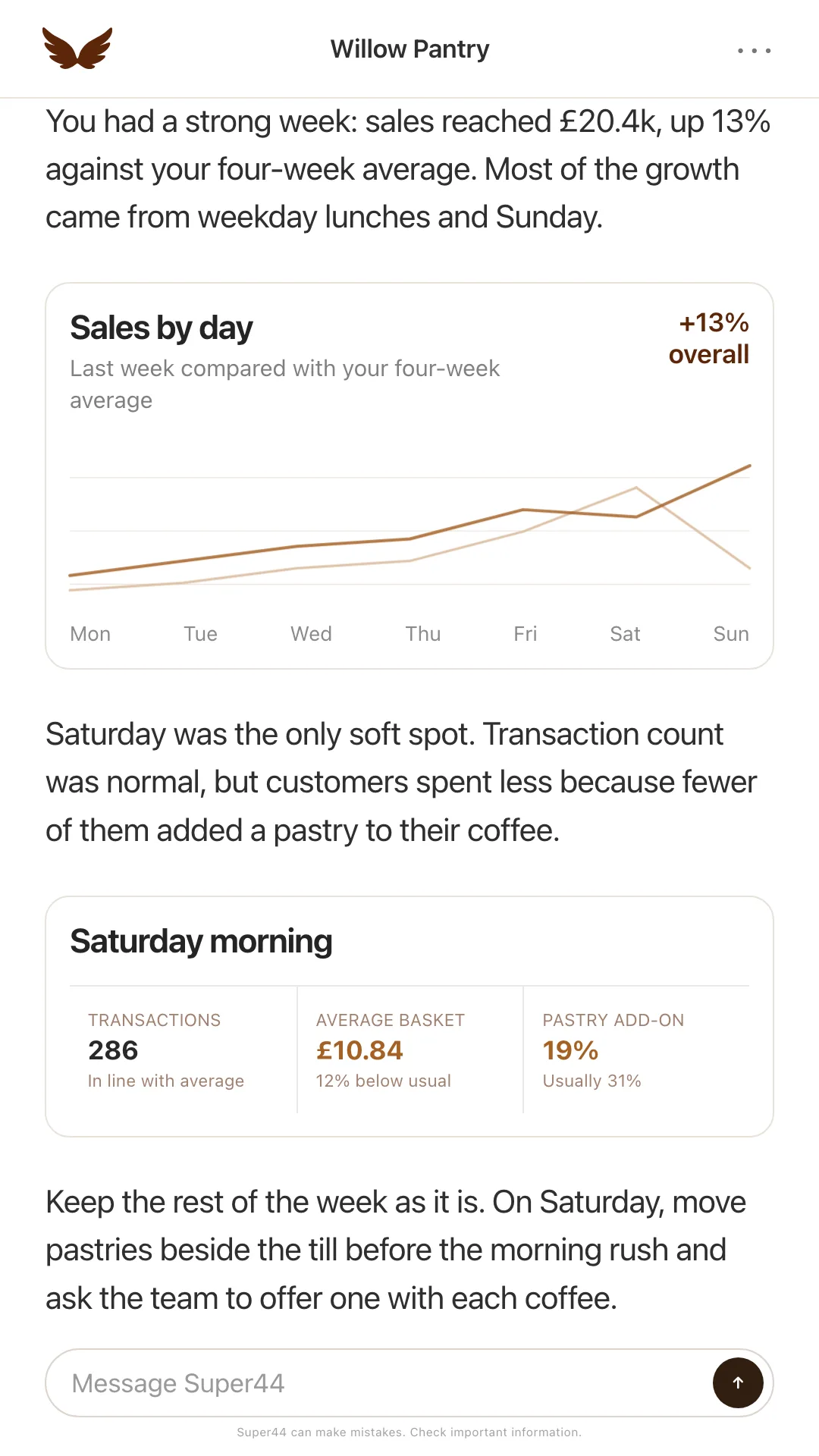
Test the hour against what it costs to staff, using your own sales by hour, before you change the sign on the door. An hour pays when its sales before VAT, less the food and drink they used, cover the wages for it. With two people costing, say, £15.50 an hour each and food and drink at 30% of sales, that's about £44 of sales before VAT every hour (£31 ÷ 0.7). A café in East London compared its own trading days in Super44: closing at 4pm capped a day at about £804, while staying open to around 8pm produced £1,062 or more.
The trap is a question the till can't answer. If you have never opened past 4pm, there are no 4 to 6pm sales to export, so the prompt asks for a trial and a break-even figure instead of a forecast. Across the cafés we work with, we see that a cut made by feel can remove a strong hour instead of a weak one, so we check every hours change against the till before it's made and track it for a month after.
ChatGPT is good at the why behind an odd week. Philipp Cheng, co-founder of the café chain Plex Coffee, said in an OpenAI case study that when a day is slow or strong, "ChatGPT usually gives an amazing explanation, like how many students are leaving, or what events are happening that week." The prompt asks for those explanations and marks them as guesses.
Check whether an hour pays
You are a café operations analyst. I run [café name], open [days and hours].
Below (or attached): sales before VAT and number of sales by hour, for each day of the last [eight] weeks, from our till.
Staff on shift: [e.g. "Mon to Fri: three until 2pm, two until we close at 4pm; Sat: four"].
Cost of one staff hour, including employer NI, pension and holiday pay: [e.g. £15.50].
Food and drink cost as a share of sales before VAT: [e.g. 30%].
The decision: [e.g. "stay open until 6pm on Thursdays and Fridays" or "close on Mondays"].

1. In a table by day and hour: average sales before VAT, average number of sales, sales per staff hour, and wages as a % of sales.
2. For each hour, work out what's left: sales minus food and drink cost minus wages. Show the formula.
3. Mark the hours where that is negative in more than half of the weeks.
4. For the decision, give the change per week and per quarter in £, and what I would give up.
5. If we have never opened in the hours the decision adds, say so. Give the sales per hour needed to break even and suggest a four-week trial instead of a forecast.
6. Point out weeks that look unusual (bank holidays, weather, school holidays) and leave them out of the averages. Mark any outside explanation as a guess.
7. If a number is missing, say which one. Do not guess it.How do I write the specials board with the allergens checked?
Let ChatGPT write the board and list the allergens from the recipe you give it, then check every line against your recipe cards and the labels on what you buy in. The Food Standards Agency names 14 allergens a food business must declare, and for loose food you must give allergen information for every item that contains any of them.
The risk sits in what you buy in. "Pesto" can mean pine nuts or cashews, a bought-in brioche can hold egg, milk and wheat, and one granola can hold four allergens on its own. The prompt makes the model flag every ingredient it can't be sure of. Sandwiches you wrap in the morning for the grab-and-go fridge are a separate case: the FSA treats food packed on the premises where it's sold as prepacked for direct sale, and it needs a label with the full ingredients list and the allergens emphasised.
Write the specials board with allergens
You write the specials board for [café name], an independent café in the UK.
Tone: [e.g. "plain and warm, a little dry humour"].
Today's specials, with every ingredient from our recipes, including what is in anything we buy in (bread, pesto, granola, sauces, dressings):
[e.g. "Smashed avocado on sourdough: avocado, sourdough (wheat flour, rye flour, water, salt), chilli flakes, lime, feta, pumpkin seeds"]

For each special give me:
1. A board line under 12 words.
2. A menu description under 25 words.
3. The allergens it contains from the UK's 14 (celery, cereals containing gluten, crustaceans, eggs, fish, lupin, milk, molluscs, mustard, peanuts, sesame, soybeans, sulphur dioxide and sulphites, tree nuts), each with the ingredient it comes from.
4. Every ingredient you can't be sure about, and what to check on its label.
Don't add ingredients, garnishes or claims I haven't given you. Don't call anything vegan or gluten-free unless I say so.
Keep your allergen matrix as the record and let ChatGPT own only the words on the board. It has no way of knowing your supplier changed the brioche last Tuesday.
How should I reply to reviews and write this week's post?
Draft both from the facts of your week, then publish them yourself: ChatGPT writes the words and leaves the posting to you.
Reply to a Google review
In BrightLocal's 2026 survey of 1,002 US consumers, 50% said generic or templated replies put them off, so the prompt gives ChatGPT what happened on the day. Google's own advice is to "Keep it short and simple", and it says you don't need to thank every reviewer publicly. For the hard ones, a one-star review with the facts muddled or a review naming a barista, our guide to replying to Google reviews with AI has a prompt for each.
Reply to a café review
You are [your first name], owner of [café name], an independent café in [town], replying to a Google review in your own voice.
Review ([number] stars): [paste the review].
What happened on our side: [e.g. "Saturday 11am, one barista off sick, brunch orders took 25 minutes"].
What we've changed, if anything: [e.g. "a third person on Saturdays from 10 to 1"].
How we talk: [e.g. "warm, plain, no exclamation marks"].

Write two versions, each under 60 words:
- name the specific thing they mentioned (the drink, the dish, the wait);
- apologise only for what went wrong, and mention a change only if I've given you one;
- no "we value your feedback", no offer of free food or discounts, no surnames;
- sign off with my first name.
For a 4 or 5-star review, thank them for the one thing they praised, in under 30 words.Write this week's post from a photo of the counter
Google archives a Business Profile post after six months unless it has a date range, so give an offer its dates and post something new each week. Leave your phone number out of the text: Google says posts with a number it can't verify as the business's might be rejected. Our guide to Google posts for restaurants covers what to post and how often.
This week's post from a photo
You write the weekly posts for [café name], an independent café in [town].
Attached: a photo of [e.g. "this morning's counter: cinnamon buns, pistachio croissants, the new batch brew"].
What's new this week: [e.g. "cinnamon buns every Saturday from now on"].
Offer, with dates, if any: [e.g. "batch brew and a bun for £5, Monday to Friday until 30 November"].
Opening hours this week: [hours].

Write:
1. A Google post: two or three sentences on what's new and when, no hashtags, no phone number, and the button that fits best.
2. An Instagram caption under 40 words, the way we talk at the counter, with no more than three hashtags.
3. One line of alt text describing the photo.
Use only the prices, dates and items I've given you. Tell me if the photo doesn't match the text.Can ChatGPT do this every week without you?
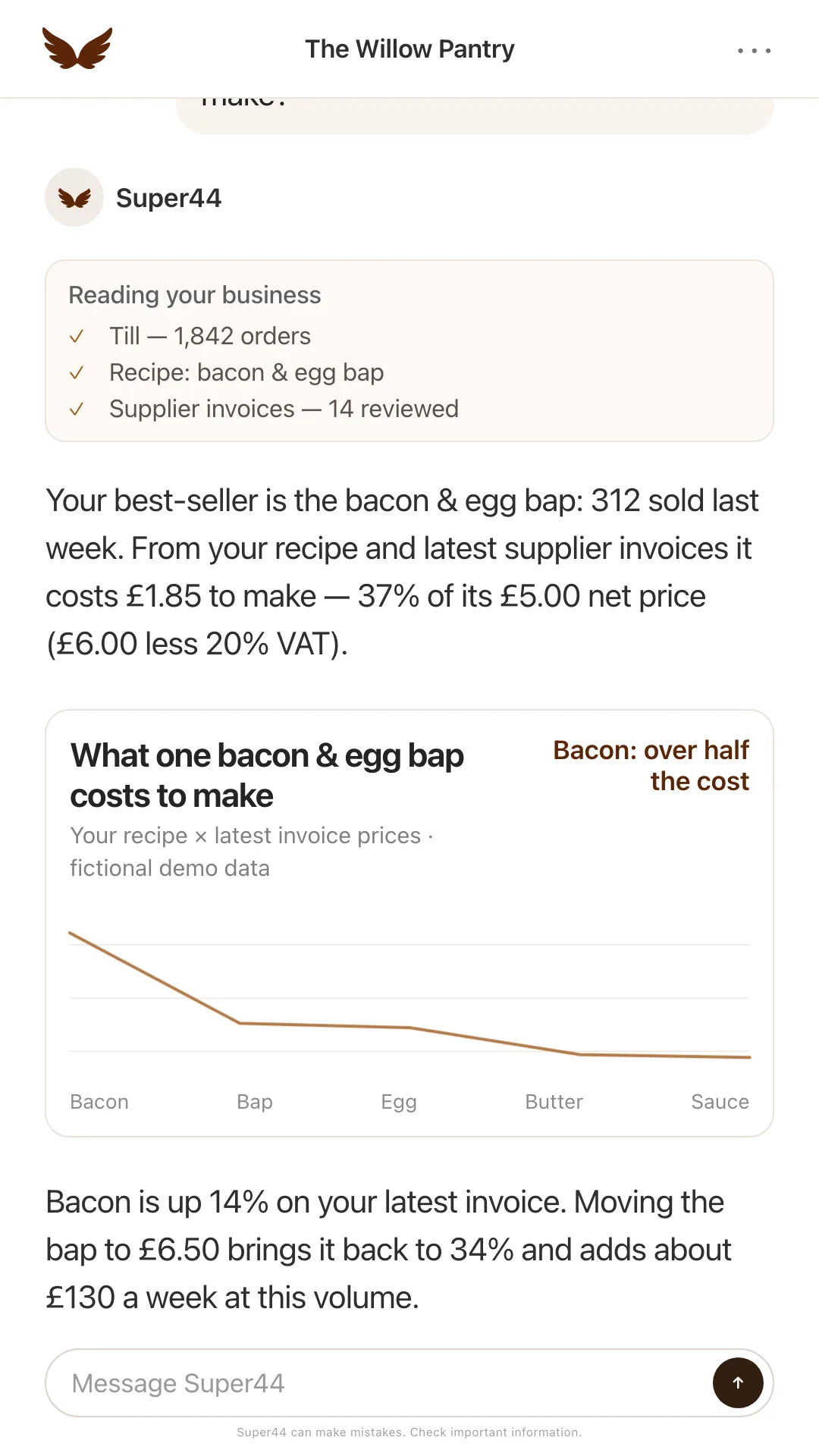
Not on its own: every prompt above starts with something you export, paste or copy, and the answer is only as current as that. In the demo café below, Super44 read a 14% bacon rise from the latest invoice, costed the bestselling bacon and egg bap at £1.85, 37% of the £5.00 it brings in after VAT (£6.00 on the board), and suggested £6.50 on the board to bring it back to 34%.
That weekly part is the job Super44 does. Your supplier invoices come in from Gmail, as a photo or in the chat, and Super44 reads each one against your saved recipes. When bacon goes up, it names the dishes the rise hits and what the bap now costs, and when you ask, the price that restores its margin: at 312 baps a week, the 50p rise adds about £130. The same check runs on the milk and beans behind your coffee list, so the costing prompt never needs retyping. At 8am the morning brief arrives from your till: yesterday's sales against the same day last week, what stood out, and one thing to change today.
Where to start this week
Start with the coffee costing, because it needs nothing but this month's invoices and gives you a price to act on today. Run any change to your opening hours as a four-week trial, so you see four of each weekday before it becomes the new sign on the door. Then work down the list:
- Run the coffee prompt with this month's milk and bean prices, and fix any drink over your target.
- Note sell-out times on a pad by the till for two weeks before you run the bake prompt.
- Before you change your hours, run the hours prompt and agree the break-even figure for the trial.
- Once you're exporting the same report every Monday, connect the till instead.
If you don't take card payments through a till yet, or your week fits on one sheet of paper, ChatGPT's free plan is all you need. If you're weighing the two side by side, Super44 or ChatGPT sets out what each one sees and what each costs.
Frequently asked questions
How can I use ChatGPT for my café?
Use it for the jobs that start with numbers you already have or words you need written: costing the coffee list, planning bakes from four weeks of item sales, checking whether an hour pays, the specials board with its allergens, review replies and the week's post. Give it a role, your real figures and the format you want, and ask for the formulas in a table. Every answer is only as current as what you paste in, so the till exports and invoice prices come back each week.
Can ChatGPT work out what my coffee costs?
Yes, if you give it your bean price per kilo, your dose, the milk in each drink and your cup costs. If you are VAT-registered, tell it to divide each price by 1.2 first, because every hot drink carries 20% VAT whether it is drunk in or taken away: a £3.60 flat white brings in £3.00, and at £20 a kilo its 18g of coffee costs about 36p. Run it again whenever a milk or bean price changes.
Can ChatGPT read my till?
Not on its own. You export the report from the till, item sales by day for bakes or sales by hour for opening times, and paste or upload it each time you ask. Super44 connects whichever till you use and reads it every night, so the same questions get answered without an export.
Can ChatGPT check the allergens on my specials board?
Only from the ingredients you give it. UK food law names 14 allergens, and for loose food you must give allergen information for every item that contains any of them. Paste full recipes, including what is in bought-in pesto, bread or granola, make it flag anything it cannot confirm, and check each line against your recipe cards before the board goes up.
Which ChatGPT plan does a café need?
The free plan runs every prompt here, with limits on uploads such as till exports and photos. Projects, which keep your recipes and tone between chats, are on every plan; the paid plans, from Go up, add scheduled tasks and higher limits. Both still work from the figures you give them, so new prices and new sales have to be pasted in.
Sources
- HMRC: Catering, takeaway food (VAT Notice 709/1) — "Hot takeaway drinks are standard-rated." Standard rate applies to food and drink supplied for consumption on the premises. Cold takeaway food and drink zero-rated unless of a type always standard-rated. Checked 22 November 2026.
- Rounton Coffee: How to price drinks at your coffee shop (7 April 2026) — A £20 1kg wholesale bag gives around 55 shots; 18g of ground coffee per double espresso as a starting point; measure leftover milk poured back over a shift to find milk waste.
- ONS: CPI annual rate, 01.2.1.1 Coffee (series L7LM) — Annual rate 18.0% in July 2025; minus 1.5% in October 2026. Released 18 November 2026.
- The Guardian: First the £10 pint, now the £6.50 flat white, by Helena Horton (13 July 2026) — Source of the Paul Rooke (executive director, British Coffee Association) quote. David Abrahamovitch, founder of Grind: a £4.10 flat white yields 18p profit after £1.60 staff, 55p mugs and paper cups, 96p core operating costs, 68p VAT and 13p other costs.
- ONS: Artificial intelligence in UK businesses, 2023 to 2026 (20 July 2026) — Accommodation and food services among the industries that most commonly report using free-to-use AI software; large language models the most widely used AI technology among businesses with 10 or more employees in June 2026 (18%).
- ChatGPT: Plans and pricing — Projects on every plan, Free included; Free has limited uploads; scheduled tasks on Go, Plus and Pro. Checked 22 November 2026.
- OpenAI: Plex Coffee delivers fast, personal service with ChatGPT (15 October 2025) — Customer case study published by OpenAI. Source of the Philipp Cheng (co-founder, Plex Coffee, a café chain) quote on explaining slow or strong days.
- Food Standards Agency (GOV.UK): Allergen guidance for food businesses — The 14 allergens; allergen information for every non-prepacked item that contains any of them; prepacked for direct sale food needs a label with a full ingredients list and allergens emphasised. Updated 23 November 2026.
- BrightLocal: Local Consumer Review Survey 2026 (11 February 2026) — 1,002 US adult consumers. Generic or templated replies put off 50% of consumers; 80% are likely to use a business that responds to all of its reviews.
- Google Business Profile Help: Tips to get more reviews — "Keep it short and simple"; you do not need to thank every reviewer publicly.
- Google Business Profile Help: Create and manage posts on your Business Profile — Posts older than six months are archived unless a date range is set; posts with a phone number in the description might be rejected if it cannot be verified as the business's; posts can be scheduled.